
by Clair Mooney | 13 Mar, 2019 | Main News Feed
Since the publication of the Hackitt Review in spring 2018, the construction industry has been working hard to meet the various challenges set for it.
The CPA has established its own Marketing Integrity Group (MIG) to specifically address Chapter 7 of the report, which challenges how product information is made available to the wider supply chain. In order to inform its work further, the group is issuing a Call For Evidence. FIS will be providing a direct response to the MIG. If members have any key points that they would like included, please email details to iainmcilwee@thefis.org
Areas of interest covered are:
- Ease of finding information
- Product substitution
- Completeness and correctness of information
- Products as part of a system, or use in a variety of applications
If members also wish to respond directly, the Call For Evidence survey is available online. It should take approximately 15 minutes to complete. The survey will close on Friday 5 April.
by Clair Mooney | 12 Mar, 2019 | Main News Feed
The Department for Education (DfE) is launching a Call for Evidence on Building Bulletin 100: Design for Fire Safety in Schools, (BB100).
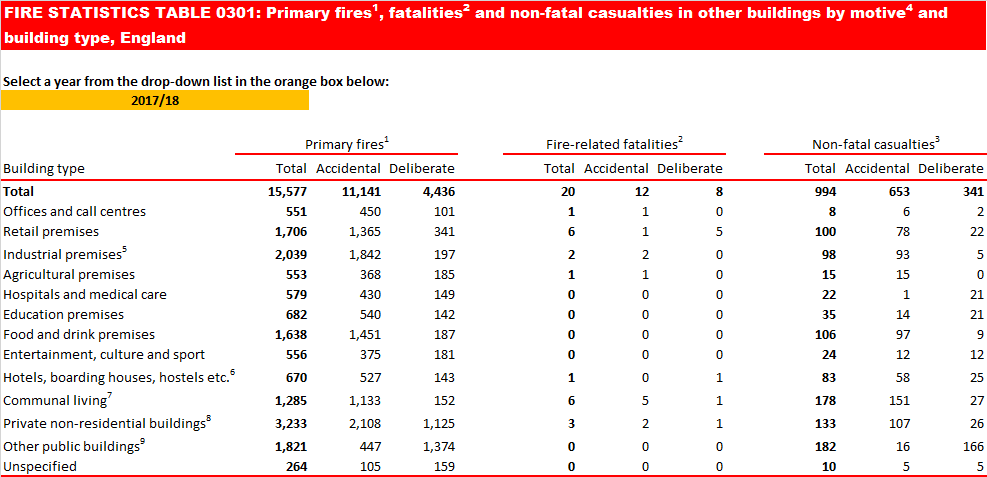
The aim of the consultation is to ensure the Department for Education’s guidance to those who build schools is fit for purpose and aligns with the Ministry of Housing Communities and Local Government’s (MHCLG) wider review of fire safety, we are launching a call for evidence on BB100 ahead of a consultation and thorough review. Fire in schools remains a concern in the UK with 682 instances recorded in educational premises in 2017/2018. Whilst there have been no fatalities in school fires since the 1940’s, the cost to the local community can be significant. Please send any information or views that you feel you would like to see included in the FIS response to joecilia@thefis.org by 24 May, so that we can include in our final submission by 31 May 2019.
https://www.gov.uk/government/consultations/review-of-building-bulletin-100-design-for-fire-safety-in-schools

by Clair Mooney | 12 Mar, 2019 | Main News Feed
Osborne chief executive Andy Steele has said the industry “can’t afford” to tackle late payment under the current market climate.
In an interview with Construction News, Mr Steele said a “perfect storm” had formed for many contractors due to the current financial squeeze and pressure from government to improve payment practices. Mr Steele stated that the financial sector has had a “change in appetite” towards construction, pulling away from its exposure to the sector, making access to finance tougher for contractors.
Amid this financial squeeze, government has cracked down on late payment practices. All companies with turnover greater than £36m and 250 employees or more are required to submit their payment practice data to government.
But Mr Steele says that the industry “can’t afford” to improve its payment practices while banks are pulling away from financing construction companies. This is because in order to pay your supply chain earlier would require companies to take out loans to fund this, as historically, contractors have “held the cash to get their business models to work”, he said. This has created an “impossible situation” for a lot of the industry: “Those two dynamics do not work together,” he said.
Although the Osborne boss doesn’t doubt that companies want to pay their supply chain quicker – “and quite rightly, they should be paid quicker” he said – it is not possible to do so at present.
“You can’t just dictate down to companies that you have to suddenly comply with these changes in your payment practices, because the industry can’t afford it,” he said. “It can’t do it in one go.”
Mr Steele said the business model “can’t change overnight” and that there must be “a realistic understanding from government over the state of the construction industry today”.
He added both public and private sector clients need to start paying main contractors earlier.
“If best payment practice is 30 days, then money from the customer has to come earlier than 30 days,” the Osborne chief said. He added large tier ones with big borrowing requirements who have historic poor payment performance are under a “huge amount of pressure” and could face difficulties. He added it is in “nobody’s benefit” if these big companies “get into trouble”.
FIS CEO Iain McIlwee responded: “Whilst I don’t like the message, I am glad that Andy put his position out there. If we break down problems and draw issues out in the open, we can start to make genuine changes – we need more transparency in our supply chain. We have wrongly used payment as a blunt instrument to manage quality. Whilst we are now accepting that this cannot and does not work we find ourselves in a position that we are addicted to this extra line of credit and in an uncertain climate finding it difficult to raise alternative funding. I agree with Andy that it is “nobody’s benefit” if these big companies “get into trouble”, but is also unacceptable for them to limp along on the backs of hardworking subbies – it is also “nobody’s benefit” if these companies fail. He also makes a good point in that, if payment to the supply chain is to be enacted 30 days, then there needs to be some fat built into this to enable money to flow and be available to pay – i.e. clients need to pay earlier, this warrants more attention. I am also convinced more can and should be done to underwrite construction, it remains the third largest sector in the UK economy – we could do with more support from the biggest (the finance and banking sector) to manage change and support investment in innovation – this is surely in the national interest!”
Source: CN News

by Clair Mooney | 11 Mar, 2019 | Main News Feed
The Department for Business, Energy and Industrial Strategy (BEIS) is putting on a series of Preparing for Brexit webinars which are designed to help businesses to ready themselves in the event of the UK leaving the EU on Friday 29 March 2019 without a deal. They will cover many of the most important changes that you should be aware of and actions that you can take now, where appropriate. Each of them will be an hour long, including Q&A at the end.
Tue 12 Mar 2019, 10:00 – 11:00: Regulations and Standards, covering using the CE and UK Mark, labelling and notified bodies
https://www.bl.uk/events/webinar-preparing-for-brexit-regulations-and-standards-mar19
Mon 18 Mar 2019, 13:00 – 14:00: Importing and Exporting, covering customs procedures, VAT and excise
https://www.bl.uk/events/webinar-preparing-for-brexit-importing-and-exporting-mar19
Tue 19 Mar 2019, 12:00 – 13:00: Business Legal Requirements, covering operating legally in the EU, cross-border mergers and accounting/auditing requirements
https://www.bl.uk/events/webinar-preparing-for-brexit-business-legal-requirements-mar19
Wed 20 Mar 2019, 11:00 – 12:00: Intellectual Property, covering registered and unregistered design rights, trade marks, copyrights, patents and exhaustion
https://www.bl.uk/events/webinar-preparing-for-brexit-intellectual-property-mar19

by Clair Mooney | 8 Mar, 2019 | Main News Feed
FIS is proud to be a part of the Inspiring Change Awards Conference 2019 which will bring together a range of inspirational industry-wide speakers from diverse backgrounds, including politicians, industry stakeholders, and representatives from a wide range of sectors. The Inspiring Change Awards, highlight and reward organisations within the construction and infrastructure sector that have created more inclusive cultures in their workplaces, education, and the community.
The conference will take place on Tuesday 21 May 2019 from 10.00-16.30 at No 11 Cavendish Square, London, W1G 0AN.
The event is free to attend and will share client expectations and good practice from within the construction industry and beyond to advance the understanding of the business and societal benefits of developing a culture of Fairness, Inclusion and Respect within the workplace. Attendees will be able to network with 300 like-minded professionals.
For more information about the conference, how to enter the awards and take advantage of award sponsorship opportunities visit the website at: www.inspiringchangeawards.com or email Brionywickenden@ceca.co.uk

by Clair Mooney | 8 Mar, 2019 | Main News Feed
IP and Brexit
Since issuing a circular on this subject on 28 February 2019, another update issued on 1 March has appeared on the GOV.UK/EUEXIT website. Please click here to view.
In addition to the above information on Intellectual Property, more specific information concerning Traded Marks was issued on 1 March 2019. Please click here to view.
• Once the UK leave the EU without a deal, EU Trade Marks (EUTMs) will no longer provide protection in the UK
• UK protection will be preserved by the government revising UK law to provide holders of existing EUTMs with a comparable UK trade mark on exit day
• From exit day, all existing registered EUTMs will be treated as if they had been applied for and registered under UK law
• For all registered EUTMs a comparable UK trade mark will be created which will be recorded on the UK register
• These UK rights will retain the filing dates recorded against the corresponding EUTMs and will also inherit any priority and/or seniority dates.
• They will be fully independent UK trade marks which can be challenged, assigned. Licensed or renewed separately from the original EUTM.
• These comparable rights will be created at no cost to the original holder of the EUTM.

by Clair Mooney | 8 Mar, 2019 | Main News Feed
MHCLG has extended the deadline for responses to the Call for Evidence for Approved Document B (Fire safety) to 15 March 2019 due to some respondents being unable to submit their reply due to technical reasons. We would encourage individual members to also respond directly with your views and evidence using the attached form to ADBconsultation@communities.gsi.gov.uk
We have submitted the attached response which has been sent to The Ministry of Housing, Communities and Local Government (MHCLG).
If you have any additional points that we should consider as part of our ongoing work on this subject, please do feed them in. Also we-d be grateful if people send us any direct responses you have submitted.
Please call Joe Cilia on 07795 958 780 if you have any questions.

by Clair Mooney | 8 Mar, 2019 | Main News Feed
CSCS has confirmed that the Grandfather Rights scheme will be phased out from 2020 and will be abolished completely from 2024.
The scheme – officially known as Industry Accreditation – allowed workers to obtain CSCS cards based on their industry knowledge and an employers’ recommendation rather than the achievement of a recognised qualification.
CSCS closed Industry Accreditation to new applicants in 2010 but those already holding a card are currently able to renew on the same basis.
From 1 January 2020, all cards renewed under Industry Accreditation will expire on 31 December 2024 and CSCS will stop issuing the card from 30 June 2024.
CSCS chief executive Graham Wren said: “Following the closure of the Construction Related Occupation card and the Construction Site Visitor Card, cards gained by Industry Accreditation are the only cards in the CSCS scheme which do not require the cardholder to achieve a recognised qualification.
“Industry Accreditation does not support industry’s desire for a fully qualified workforce and as such it will be withdrawn.”
What each of the 60,000 Industry Accreditation card holders need to do next depends on their occupation and any qualifications they may already hold.
Those without qualifications will be required to register for the appropriate qualification for their occupation before their cards expire in 2024.
Wren added: “A lot of work has taken place to ensure those with cards issued under Industry Accreditation will be able to transition to other CSCS cards as simply as possible.
“We are making this announcement early to ensure card holders and their employers have enough time to make the necessary alternative arrangements.”
The withdrawal of Industry Accreditation will be the final step towards achieving the Construction Leadership Council’s objective of ensuring cards are only issued to those who have achieved, or are in the process of achieving, a nationally recognised construction related qualification.
For more information click here
by Clair Mooney | 8 Mar, 2019 | Main News Feed
This will come info force on 1 October 2019. Although this might seem like some time away, this change will see VAT being paid between construction firms ‘reversed charged’ which will have consequences for your cashflow and accounting systems.
We recommend members take a look at the JTC guidance and also seek advice from your accontants. The Policy Paper details the reform and details the impacts. The Government has also produced a Guidance Note.