0121 707 0077

Institute for Apprenticeships and Technical Education Survey

Institute for Apprenticeships and Technical Education Survey

A report setting out the learning and assessment experiences of more than 1,000 apprentices has been published today.  The 27 members of the Institute’s panel of apprentices, who represent the views of learners to apprenticeship policy makers, have reported on the responses and published recommendations for change. This is accompanied by the Institute’s analytical data report and tables.

The documents show that even with the COVID-19 outbreak, 87% of apprentices surveyed said they would recommend their apprenticeship to other people wanting to train in their occupation.  Most also believe (81%) they have been equipped with skills enabling them to adapt to future developments within their industry, while 82% felt satisfied their apprenticeship had laid the foundation for a successful career.  For more information please see Institute for Apprenticeships Survey.

60% of local authorities delay fire door programmes – leaving safety to chance

60% of local authorities delay fire door programmes – leaving safety to chance

Fire Door Safety Week exists to stamp out the legacy of fire door neglect and to educate on the importance of fire door safety. To launch this year’s campaign, the organisers have shared research into the state of fire door maintenance, inspection and replacement programmes across local authority owned and managed housing in the UK.

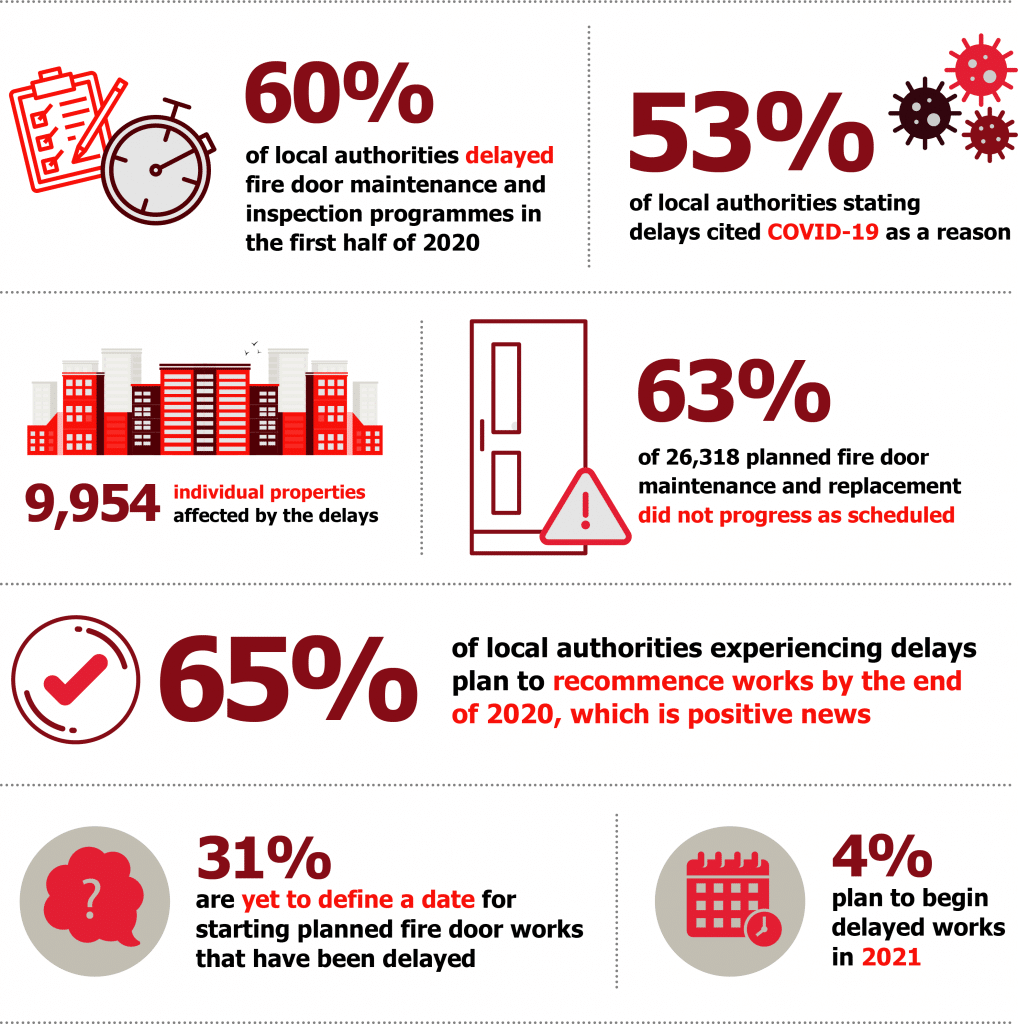
Over half (52%) of UK local authorities responding to a Freedom of Information (FOI) request reported delays to planned fire door maintenance and replacement in the first half of 2020. The number rises to 60% when inspection delays are also factored in.

According to the data obtained from 147 local authorities that own and manage their own housing stock, at least 26,318 fire doors were scheduled for maintenance or replacement between January and June 2020, but 16,580 did not progress – meaning 63% of individual planned works were delayed until at least the second half of the year, affecting a minimum of 9,954 individual properties.

In addition to delays to maintenance and replacement in the first half of the year, 31% of all responding local authorities stated their fire door inspection programmes were delayed, affecting at least 12,596 fire doors.

Not all responding local authorities provided reasons for delay, but over half (53%) of those experiencing delays cited COVID-19-related restrictions, including limited property access and availability of contractors due to social distancing guidelines. However, it was positive that several local authorities proactively mentioned that emergency repair works to fire doors continued throughout the lockdown period to maintain the safety of residents.

Of those local authorities that experienced delays, 65% intend to commence works by the end of the year. This signals that the majority recognise the importance of properly fitted and maintained fire doors. However, worryingly 31% of local authorities stated that they are yet to define a date for recommencing the planned works.

The findings follow an open letter from the London Fire Brigade to all housing providers in the Capital urging them to put plans in place ahead of new fire safety legislation coming into effect. The letter strongly advises building owners to consider the risks of existing fire doors in their fire risk assessments, regardless of the height of the building.

Fire’s don’t stop – it’s time to prioritise fire doors

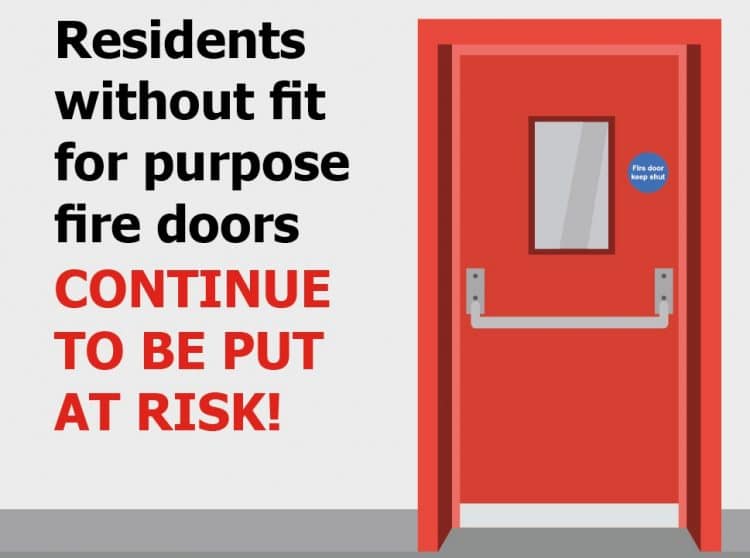
It’s clear COVID-19 has understandably impacted on service delivery across a variety of sectors, but fires don’t stop. With the UK lockdown period forcing many people to spend more time at home, people without fit for purpose fire doors have been put at risk. There is a need for continued and urgent focus on ensuring the safety of all building occupants whether in local authority or privately-rented accommodation, workplaces or other building types.

Whilst we have focused upon local authority owned and managed housing stock, we strongly suspect that our insight reflects the wider market. We hope that through this years’ Fire Door Safety Week, we can draw attention to these important issues and encourage all with responsibility for fire doors to take urgent action across fire door maintenance, inspection and replacement.

When it comes to fire door inspections, fire doors can become damaged at any time, especially where they are frequently used. If a damaged door goes unidentified it cannot perform its life-saving role. Like previous years, this year’s Fire Door Safety Week campaign will emphasise the importance of regular inspections, carried out by trained and competent professionals.

A wealth of fire door information and guidance is available free of charge from the Fire Door Safety Week Toolkit, including the Fire Step Fire Door Check, which easily helps to identify fire doors that are not fit for purpose.

Download the Fire Door Safety Week Report here

Health and Safety Update – COVID 19

Health and Safety Update – COVID 19

In light of new guidance across the UK, FIS provides some vital updates below:

Contact Tracing App Launched

The NHS COVID‐19 app has been launched in England and Wales to help control the spread of coronavirus. Although not legally required to do so, construction sites can create a unique NHS QR code and posters to display at each site entrance. Sites can also play their part by encouraging their workforce to download and use the app outside of work

Face Coverings (England)

This week we have seen the increased requirements for the wearing of face coverings in specified places announced this week.

There are no additional specific requirements for construction sites however the requirement for face coverings to be worn in premises providing hospitality (bars, pubs, restaurants, cafes), except when seated at a table to eat or drink applies to canteens.

The CLC has reviewed its guidance on The Use of Face Coverings in Construction and is proposing to update its position as below.

CLC position

Where workers on site are not required to wear Respiratory Protective Equipment (RPE) and their workplace (which may include welfare and changing facilities, site offices or site meeting rooms) meets all of the criteria below, their employer should make face coverings available and they should be worn:

    • an enclosed space;
    • where social distancing isn’t always possible; and
    • where they come into contact with others they do not normally meet.

In line with Government guidance on premises providing hospitality, face coverings must be worn in canteens except when seated at a table to eat or drink.

This document will remain as guidance for employers with the objective of achieving a consistent approach across the industry.

Further information on use of face coverings and guidance for the Finishes and Interiors Sector is available in the FIS H&S Toolkit

Car Sharing (Scotland)

In her update this week the First Minister stated:

“The last new restriction I want to cover today relates to travelling by car. It may seem minor but it is important.  We know, again from Test & Protect data, that sharing car journeys presents a significant risk of transmission.  We are therefore advising against car sharing with people outside your own household.  We are therefore advising against car sharing with people outside your own household.”

This has been reviewed through the CICV in Scotland H&S working group and the conclusion is that there is no need change to the advice previously issued is required.

It remains the official advice from Transport Scotland:

There remains occasions when there is no alternative but to travel with people from out with your household. This should be limited as much as possible.  On such occasions, you should:

  • keep to small groups of people, up to 6 at any one time
  • keep your distance and take care entering and exiting the vehicle
  • sit as far apart as possible in the vehicle, avoiding face-to-face
  • maintain good ventilation by keeping the car windows open
  • wear a face-covering, unless you are exempt
  • clean your hands before and after your journey
  • if the vehicle is your responsibility, clean the door handles and other areas that people touch.
  • If you regularly share transport whether it is a car or minibus or other private vehicle, try and share with the same people each time

Full details from Transport Scotland here

Guidance on complying with restrictions in Scotland is available in the Finishes and Interiors Sector is available in the FIS H&S Toolkit

Coronavirus Testing

If a member of the workforce shows any of the three main COVID‐19 symptoms, they should get a test within five days and self‐isolate until they have received their test result. In accordance with Government guidance, colleagues who were in close contact do not need to self‐isolate, unless requested to do so by NHS Test and Trace. They should be informed that a colleague (who should remain anonymous) may have COVID‐19 and they should take extra care in practising social distancing and good hygiene.

Employers who are informed of more than one confirmed case should contact their local Public Health England Health Protection Team

Chancellor Rishi Sunak announces Job Support Scheme to replace furlough from 1 November

Chancellor Rishi Sunak has today announced his new Winter Economy Plan featuring a new Jobs Support Scheme to replace the existing furlough scheme.

The Job Support Scheme

Starting in November, the scheme will run for six months.

It will be available for employees working at least a third of their normal hours, who are being paid for that as normal.  Employers and government will be jointly responsible for incresing their wages to cover two-thirds of their lost pay.  

Through the scheme, employers will continue to pay the wages of staff for the hours they work.  For the hours not worked, the government and the employer will each pay one third of their equivalent salary.  This means employees who can only go back to work on shorter time will still be paid two thirds of the hours for those hours they can’t work.

In order to support only viable jobs, employees must be working at least 33% of their usual hours. The level of grant will be calculated based on employee’s usual salary, capped at £697.92 per month.

All small and medium-sized businesses are eligible, however larger organisations must be able to show that their turnover has declined during the pandemic.  It is designed to sit alongside the Jobs Retention Bonus and could be worth over 60% of average wages of workers who have been furloughed – and are kept on until the start of February 2021.  Businesses can benefit from both schemes in order to help protect jobs.

Support for the Self Employed

Government is continuing its support for millions of self-employed individuals by extending the Self Employment Income Support Scheme Grant (SEISS). An initial taxable grant will be provided to those who are currently eligible for SEISS and are continuing to actively trade but face reduced demand due to coronavirus. The initial lump sum will cover three months’ worth of profits for the period from November to the end of January next year. This is worth 20% of average monthly profits, up to a total of £1,875.

An additional second grant, which may be adjusted to respond to changing circumstances, will be available for self-employed individuals to cover the period from February 2021 to the end of April – ensuring our support continues right through to next year. This is in addition to the more than £13 billion of support already provided for over 2.6 million self-employed individuals through the first two stages of the Self Employment Income Support Scheme – one of the most generous in the world.

Additonal Support Measures

Businesses that succesfully applied for a BounceBack loan can now extend their terms from six to 10 years as part of the “pay as you grow” scheme.  This aims to help cashflow allowing payments to be reduced.

If a business is in real trouble, then they can opt for interest-only payments or suspend repayments for six months.  It has been confirmed that credit ratings will be unaffected.

The government guarantee on Coronavirus Business Interruption Loans will be extended to 10 years and a new successor loan guarantee programme will be announced in January.

In addition, the Chancellor also announced he would be extending applications for the government’s coronavirus loan schemes until the end of November.

Businesses that deferred their VAT payments earlier this year will now have the option to repay in 11 interest‐free instalments during the 2021‐22 financial year, rather than in one lump sum at the end of March 2021, to help with cashflow.

You can read the full Winter Economy Plan outline report here

Visit our Covid Hub for all the latest information


COVID compliance now a legal obligation – are you ready?

COVID compliance now a legal obligation – are you ready?

Despite spending weeks encouraging employers to bring employess back into COVID-secure workplaces, the Government last night announced a dramatic 180-degree turnaround.

The advice now is to work from home wherever possible, in an attempt to curb an increase in COVID cases.

There are however still many businesses for whom homeworking is not an option. For them, creating a COVID-secure workplace has never been more important. COVID-compliance is now a legal obligation and not meeting these standards in your workplace will result in fines of up to £10,000 and being forced to close your doors.

Wondering if your business is up-to-scratch and could confidently pass an inspection?

FIS Associate Member Citation has put together an extensive checklist of all the considerations you need to make to get your workplace inspection-ready and safe for your people. You can access the checklist here. Further guidance can be found in our H&S Toolkit

FIS Member Benefit
If you’d like to chat about how Citation can help with the HR and Health & Safety side of your business, just give them a call on 0345 844 1111, or fill in our call-back form and we’ll get right back to you.
FIS members are entitled to preferential rates on Citation’s services. Quote ‘Finishes & Interior Sector’ when enquiring to access your member benefit.

Tighter restrictions, but construction to carry on across the UK

Prime Minister, Boris Johnson today set before the House of Commons six steps designed to action to suppress the disease in England.  This follows similar steps already announced in Northern Ireland.

Step One is that office workers, who can work from home should do so.  He was, however explicit and avoided mistakes of the initial lockdown with the statement that  “key public services – and in all professions where homeworking is not possible, such as construction or retail – people should continue to attend their workplaces

The second step is that from Thursday all pubs, bars and restaurants must operate table-service only and that all hospitality venues must close at 10pm.  The same will apply to takeaways – though deliveries can continue thereafter.

The third step is to extend the requirement to wear face coverings to include staff in retail, all users of taxis and private hire vehicles and staff and customers in indoor hospitality, except when seated at a table to eat or drink.

The fourth step is confirming that, in retail, leisure, tourism and other sectors, Covid-secure guidelines will become legal obligations.  Businesses will be fined and could be closed if they breach these rules.

The fifth step is to tighten up the rule of six.  From Monday, a maximum of 15 people will be able to attend wedding ceremonies and receptions.  Though, up to 30 can still attend a funeral as now.  The rule will extend to all adult indoor team sports.

Finally, plans to reopen business conferences, exhibitions and large sporting events will not begin from 1 October.

These rules will be enforced by tighter penalties extending fines of up to £10,000 for those who fail to self-isolate to businesses breaking Covid rules.  This is significant for construction businesses and extends the penalties that HSE can impose if not adhering to strict social distancing guidelines.  The FIS COVID H&S Toolkit is available here.

The penalty for failing to wear a mask or breaking the rule of six will now double to £200 for a first offence.

Commenting on the announcement, FIS CEO Iain McIlwee stated:

“I think we had all steeled ourselves for this, but nonetheless it is a blow to hear that after months of fighting the virus we have taken a step back.  One positive is that the clarity in the speech from the Prime Minister with respect to business and construction is appreciated – it means we avoid the worst of the confusion that we experienced as a sector back in March. 

It is the wider implications that concern me more, this is clearly a blow to the hospitality sector and is likely to impact investment here, but also delay decisions around reconfiguring and enhancing workspaces. 

I hope that the Prime Minister heeded the warnings from his fellow members of the House about needing to do more to support businesses through this challenging time so that we are there to support the recovery.  I believe now he has to look carefully at the allowances available that will encourage people to invest in their buildings and enhance their working environments in readiness for a return.  A silver lining is that, without doubt the best time to get work done is when the building will be vacant.”

A full transcript of the speech is available here.  The Prime Minister will address the nation at 8pm tonight.

An Update on Scotland

In a statement to the Scottish Parliament today the First Minister introduced a number of additional restrictions the Scottish Government believes are now necessary in order to reduce COVID rates as we enter winter.

 These restrictions include:

 ·         A strict nationwide curfew for pubs, bars and restaurants – from Friday 25th September, pubs, bars and restaurants will be required to close at 10pm.

·         From tomorrow (23 September) visiting other households indoors will not be permitted.

·         Advising against car sharing with people outside your own household.

 The First Minister also underlined existing Scottish Government advice that everyone who can work from home, should work from home.  

 The Scottish Government has also announced financial support of £500 for those on low incomes who are required to self-isolate.  

 You can read the First Minister’s full speech here.


Qfqual commits to streamlining communications

Qfqual commits to streamlining communications

Ofqual has jointly released a statement with several organisations involved in assessments, committing to work together and streamline communications. This summer has been extraordinary for everyone involved in awarding vocational and technical qualifications. It has been an anxious time for learners and has involved a huge amount of hard work for centres and awarding organisations (AOs).

Everyone in the Education and Training sector has worked collaboratively to issue valid and reliable VTQ results to learners in order for learners to progress onto the next stage of their education or into work. It is a significant achievement that millions of certificates were issued, for thousands of different qualifications.

Ofqual recognise and acknowledge, however, that this achievement has been a great challenge for all concerned and will continue to be so. Colleagues right across the sector, both in centres and awarding organisations, had to make enormous efforts to secure results for learners, rapidly developing and implementing new systems and processes. Particular credit is due to colleagues working in centres for their hard work and professionalism.

It is important to learn the lessons from the summer, in particular how the Education and Training Sector can work together even more effectively to improve communications and the exchange of information between centres and AOs so that things run more smoothly in 2020/21. You may have seen that Ofqual has been consulting on the regulatory framework for 2020/21, which is, like this summer’s framework, flexible to ensure that AOs can put in place arrangements and adaptations that best suit their qualifications. But Ofqual are conscious of the need to ensure as much consistency as possible, and they recognise that collaboration will be key. AoC, AELP, HOLEX, FAB, JCQ, Ofqual, have therefore committed to work together, convening a working group to agree how centre-facing communications can be streamlined over the current academic year.

As a first step, those involved have jointly agreed that, by 23 October, awarding organisations will have started to communicate to centres their planned approach to any adaptations to their qualifications for 2020/21, to assist in mitigating disruption to teaching, learning and assessments so that, as far as possible, learners have the opportunity to receive fair results in 2020 to 2021 and are not disadvantaged by the longer-term impacts of the pandemic. They will be strongly encouraging awarding organisations to keep their centres fully informed as plans develop, and they will use this group to co-ordinate milestones and communications, and to address issues arising through the year.

A number of subject and sector groups (for example, covering Functional Skills Qualifications, and Hair and Beauty Qualifications) have work well underway to support consistent approaches to adaptations of qualifications in 2020/21. Ofqual are pleased to confirm that CCEA Regulation and Qualifications Wales will also be part of the working group going forward, and they commit to updating you on a regular basis as decisions are made and clarity achieved.

Managing risk in fit-out: The devil is in the “assumed” detail

Managing risk in fit-out: The devil is in the “assumed” detail

BLOG: Joe Cilia – FIS Technical Director

In a follow-up to his last blog ‘Addressing fire proof, no proof and value engineering’, Joe Cilia turns his attention to the ‘I have always done it that way’ argument.

This particular “old chestnut” is often brought out in defence to justify work, process or decisions based on past experiences, how the individual was trained (or shown) or what was in the last copy of a guide that was read – the assumption is that it should be ok based on experience: but here is the nub, things change, and often that change is brought about from new information, scientific research or an event.

It isn’t hard to think of some examples that we wouldn’t countenance now, but may have been considered normal back in the day:
Lead was used in in a huge range of products until people realised the harmful effects it could have when it was used in toy soldiers, paint, and petrol, all now banned.

Asbestos was billed as the “magic mineral” and used commonly in construction applications such as pipe lagging, tiles and insulation, now banned because of the risk to health.

So as our understanding improves, as innovation drives improvement, new testing, scientific research or worst case, an unfortunate event informs us, it is not unreasonable that the way we design and build evolves too.

A huge catalyst for change is that we live in a digital age. This has both upside and downside risks. Up until recently the only way we could see what was up to date and current was to wait for the revised guide to be printed or go to the source. In the information age and with mobile phone in hand, online up to-date information is far more readily available and accessible – this is great, but it also throws up new risks – information needs to be contextualised and validated.

Anyone who has seen the recordings of the BBC blog of the Grenfell inquiry where individuals are being cross examined, will quickly realise the importance of questioning and having evidence of compliancy. As competent people (who rely on our skill, evolving knowledge, ethics and experience) it is our responsibility to check, as its clear that saying ‘I thought’ does not stand up to cross examination.

In the world of fit-out, where building interfaces differ, build height, environment, compatibility with other specified elements, where ultimately there is more choice, it is vital to ensure that all of the details are carefully considered. All to often the term “contractors choice” leaves a contractor assuming design responsibility and impossible decisions rushed through because of late appointment, a lack of foresight, poor planning and pressure on programme. FIS advice is always to:

• Stop – Don’t Assume
• Check
• Confirm

I cannot stress enough how crucial this last stage “confirm” is. Even where assumptions are checked, decisions must be validated. This risk is that without thorough and robust assessment, where the implications of size, interface, compatibility of abutting materials, loadings and fittings are considered, performance may differ drastically from what was intended. In my work I have seen many examples where the performance of a product is assumed yet the installation has been altered in a seemingly small way, but that ultimately renders all proof of performance invalid and makes the
body who added the new material the ‘Manufacturer’, without the protection of warranty and liable for ensuring the safety and producing test evidence against any claims.

Suppliers too are more cognisant of the challenge and reporting that they are seeing instances of trying to “prove designs” or develop “workable solutions” based on test evidence that had been developed to manage bespoke installations, but now is being employed erroneously as if a standard
detail. This practice, coupled with the concept of extended producer responsibility and tightening regulation is driving suppliers to become more risk adverse in the publication of information and even withdrawing information that they fear could be misleading, out-dated or open to misuse.

The challenge to the market is that in a world of ultimate design freedom we create a myriad of solutions. Whilst manufacturers and contractors will continue to work with designers to overcome individual challenges, we may start to see choice constrained by compliance and the practicality of
testing and bespoke solutions, better planned, properly costed and evidence more clearly contextualised and marked for use within the constraints of that specific project.

So don’t assume that what was used on a previous job would apply to the next job or that ‘Standard details’ are still current, check with the system owner/ supplier before designing and ask for confirmation in writing and add it to the project file in case you are asked.

Joe Cilia
Technical Director FIS
September 2020