by Oscar Venus | 4 Sep, 2025 | Drylining, Skills
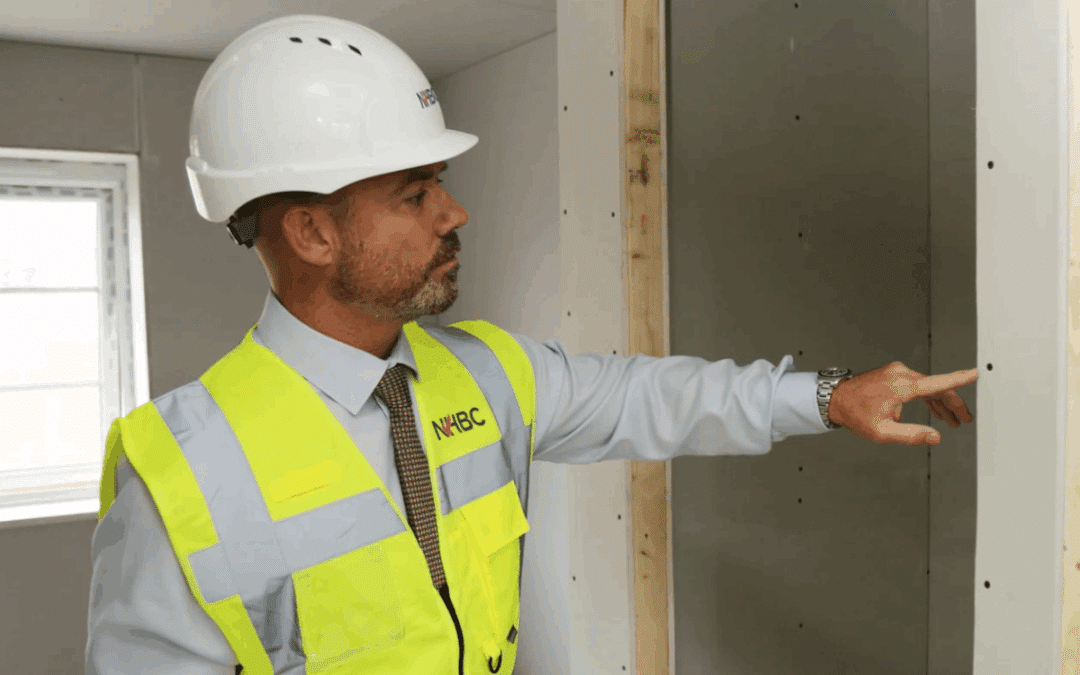
FIS and its members have collaborated with the National House Building Council (NHBC) and HBF to launch a new series of drylining masterclasses aimed at improving skills, quality, and compliance within the construction industry.
These Dry Lining Masterclasses are designed to deliver practical skills and knowledge on the most common dry lining issues found by our inspection teams.
Developed to support both new entrants and experienced professionals, these practical training sessions will be delivered at NHBC’s network of training hubs. The programme is designed to raise standards across the drylining trade, a critical element of modern building interiors that often lacks structured training opportunities.
The Dry Lining Masterclass content has been tailored to cover the following key areas:
- defect statistics
- when dry lining and plasterboard can start
- plasterboard fixings
- dry lining
- fire safety
- sound insulation
- consistent approach to finishes.
This joint initiative supports wider efforts to address the growing skills shortage in the construction sector and reflects a shared commitment to driving up standards across UK housing and commercial developments.
By enhancing knowledge and practical capability in drylining, the training aims to improve quality, boost productivity, and help build a more competent workforce.
To access/book onto the courses or to find out more click on the following links
Dry Lining Masterclass – NHBC
Dry Lining Masterclass open course – NHBC

by Oscar Venus | 29 Aug, 2025 | Technical
BS EN ISO 9001 (quality management systems, requirements) is currently under review by BSI and has been circulated for public comment.
Members can use the link below to login to the BSI portal or create a free BSI account, download a copy of the draft revised standard and submit comments through the portal.
British Standards Institution – Project
Key proposed updates include:
- Changes to requirements
- Clearer structure and terminology for improved usability
- Clarification of requirements in Annex A (informative)
The consultation is open until 20th October 2025 and we are encouraging all our members to either comment directly or engage with the FIS team if they have questions about the standard and would like to inform an FIS response.
FIS hosts regular meetings with an organisational capability working group comprised of members who will discuss this review alongside other subjects and members are welcome to get involved with this work.
Please contact jamesparlour@thefis.org or greggreves@thefis.org if you have questions of would like to get involved in any of the above.

by Oscar Venus | 29 Aug, 2025 | Skills
FIS has submitted a formal response to Ofqual’s consultation on proposed reforms to apprenticeship end-point assessment (EPA), raising concerns over the potential risks to assessment quality, consistency, and the readiness of the sector to adapt.
The consultation, which closed on 27 August 2025, outlines a new regulatory framework intended to modernise apprenticeship assessment by moving away from the traditional EPA model. The proposed system places greater emphasis on flexibility, streamlined assessment plans, and increased involvement from employers and training providers.
Earlier in the year, DfE brought in several apprenticeship reforms. The reforms were meant to “slash red tape” and introduce shorter and more flexible apprenticeships. Most reforms are understandable, but the reforms to the assessment process is causing industry-wide concerns.
A set of 5 pilots were run by Skills England with the intention of proposing assessment reforms and taking on feedback. Occupations from healthcare, IT, construction and others were selected, with Site Carpentry & Joinery installers identified for construction. Whilst this sector group is part of the pilot, these changes will impact all of the trades and installer occupations and will likely impact other occupations across the country.
While the key issues are outlined below, the way the pilots have been conducted, a poor consultation process, and the potential negative impact on apprenticeships, raises serious concerns.
Key impacts:
- An impact on the Construction Skills Mission Board to deliver against all priorities
- Apprenticeships will not meet the competence requirements set out in the Building Safety Act 22 which may result in a very real reduction of competent people in our industry.
- The construction sector will be increasingly unable to deliver essential skills through apprenticeships. Industry will likely remove apprenticeships from existing frameworks altogether, including potential calls to decouple CSCS cards from apprenticeship pathways. Without immediate intervention, apprenticeship uptake for construction is at serious risk of collapsing entirely
The perceived issues:
- Assessment bodies are likely to be Awarding Organisations (AO’s) or training providers:
- Assessment organisations will be able to create the assessment based on their own thinking.
- The level of detail in the assessments is now going to be set by the assessment organisations.
- If there are multiple assessment organisations, this will create varying levels of assessment, based on the organisation.
- We believe this will reduce the level of competence validation of those going through the assessment.
- Under the reforms, the New Assessment Plans have a different purpose to the current End Point Assessment Plan. The new proposed assessment plan will:
- Digital assessments will be prioritised. With a practical trade like Installers, where they physically have to demonstrate competence (stairs, fire door install), digital assessments will not work.
With regards to the pilot consultation sessions:
- Invites to the pilot meeting were issued 2 days before the meeting, with non-attendance resulting in feedback not being taken on board
- Information for the meeting being issued less than 24 hours before the meeting, with no time to review and comment
We understand that Skills England have been asked to implement these principles within the boundaries of the apprenticeship reforms.
If you have any feedback or queries, please contact beenanana@thefis.org

by Oscar Venus | 29 Aug, 2025 | Events, Health and Safety
Learning for Everyone
The Lighthouse Wellbeing Academy provides a flexible, accessible approach to learning designed to support the mental health and wellbeing of everyone in the construction industry.
Their Courses include self-paced eLearning, live online Wellbeing Exclusives led by expert tutors, and accredited Mental Health First Aid (MHFA) courses.
Whether you’re a site operative, project manager, or office-based professional, there’s a course tailored to your needs. From soft skills development to industry-recognised MHFA qualifications, the Academy will support your journey toward better mental health.
Best of all, most of the training is completely free, because positive cultural change starts with accessible education.
For more information, please see the link below or contact Marie Flinter at FIS:
Wellbeing Academy – Lighthouse Charity

by Oscar Venus | 28 Aug, 2025 | Technical
The Government has updated its guidance under the Fire Safety (England) Regulations 2022, clarifying expectations around fire doors in residential and multi-occupied buildings.
The revised guidance, published in August, reinforces that fire doors do not necessarily need to be replaced if they met the requirements of Building Regulations at the time of installation and have since been appropriately inspected and maintained.
This update is intended to provide reassurance for building owners, managers, and residents, while underlining the importance of regular checks to ensure that fire doors remain in good working order.
FIS is reminding members that compliance is not just about product selection, but also about inspection, maintenance and record-keeping. Routine checks should be carried out in line with the regulations, and residents provided with clear information on the role of fire doors in maintaining building safety.

by Iain McIlwee | 27 Aug, 2025 | Main News Feed
On 1st July 2025 Build UK published Version 5 of the
Common Assessment Standard (CAS). Significantly the
Building Safety section, introduced in 2024, will now become
mandatory for all FIS Members undertaking regulated design or building work (not just Higher Risk Buildings).
Principal Contractors are advising that Specialist Contractors in their supply chain should have successfully completed the Building Safety section by 1 October 2025.
What does this mean to FIS Members?
If your company is already CAS certified through one of the recognised Pre Qualification Questionnaire (PQQ) providers (e.g CHAS, Constructionline, Achilles etc), you will need to complete the new mandatory Building Safety question set as part of the updated overall question set the next time you renew or go through the certification process with a Recognised Assessment Body.
The Common Assessment Standard continues to gain traction across public and private sector clients as a key tool to demonstrate organisational capability and compliance under the Building Safety Act. Certification is required only once via any of the Recognised Assessment Bodies, and businesses are encouraged to review their current accreditations to avoid duplication and reduce unnecessary bureaucracy in pre-qualification.
FIS has (since Version 5 was published) been invited to join the working group that sets the standards so members are encouraged to feed any concerns or observations around the existing questions to jamesparlour@thefis.org.
FIS also hosts a mirror group that is, as well as reviewing and feeding into the assessment criteria, helping create resources and guidance to support members in completing this section including an Integrated Management Standard, a Template Building Safety Policy and a range of resources and guidance designed to help complete key questions.
Don’t Duplicate, Data Share!
The Common Assessment Standard is being used by a growing number of organisations across the industry to demonstrate that members of their supply chains have the organisational capability to fulfil their duties under the Building Safety Act. Pagabo and Structure Tone are the latest to specify it, and a full list is on the Build UK website.
Companies that have the Common Assessment Standard from any one of the Recognised Assessment Bodies do not need to obtain certification from any others. Instead, they can agree to share their data at no cost with the other Recognised Assessment Bodies so it is visible to more Contractors and Clients. Don’t duplicate: anyone wishing to see a reduction in the bureaucracy of pre-qualification should be sharing their data rather than getting the Common Assessment Standard from multiple Recognised Assessment Bodies. Giving permission to share your data is quick and simple and will help businesses across the supply chain to save time and money and win work.
If you have been certified through the Common Assessment Standard are being asked to use a specific PQQ procedure, FIS has prepared some specific wording to send to the company requesting and a whistle blowing process to help ensure that companies are not required to hold multiple accreditations.
by Oscar Venus | 22 Aug, 2025 | Technical
The British Standards Institution (BSI) is currently developing a new Publicly Available Specification (PAS) code of practice designed to support the safe introduction of construction products to the market.
The new standard – PAS 2000:2026, Construction products – Bringing safe products to market – Code of practice, aims to inform, complement, and align with the government’s forthcoming reforms to construction product regulation, following the recent Green Paper consultation.
This is an important opportunity for the finishes and interiors sector to help shape a standard that will directly impact how products are designed, assessed, and placed on the market.
The draft is now open for public consultation until 8 September 2025. We strongly encourage FIS members to review the standard and share feedback to ensure it reflects the needs and realities of our sector.
You can access the consultation via the BSI Standards Development Portal. Please note you will need to register for a free BSI account to download and comment on the draft.
If you would like to provide comments through FIS as part of a collective response, please get in touch with us by phone or email – we’d be happy to discuss your views.

by Oscar Venus | 22 Aug, 2025 | Skills
CITB has announced a number of changes aimed at “streamlining our approach to more effectively help levy-registered employers access financial support for training. To do this we have reviewed our existing offer and we are making changes. These changes are not removing the support offered by CITB to industry but are simplifying the way in which they are accessed, making it easier for employers.”
In a set of changes (listed below) FIS has highlighted concern that, the Skills and Training Fund will close from 30 September 2025 with Employer Networks becoming the sole route for business development funding. This shift is intended to reduce confusion caused by overlapping schemes and improve efficiency. The ‘Suggest a Course’ initiative will also be closed, as CITB believes Employer Networks now provide sufficient support to industry. Additionally, the Industry Accreditation grant uplift will end on 31 December 2025, earlier than planned, and a new £240 grant tier will be introduced for shorter ‘Award’ level qualifications from September 2025. These changes are being positioned as part of a broader effort to make better use of industry funds and focus on impact.
However, FIS is concerned that particularly the almost immediate withdrawal of the Skills and Training Fund removes a valuable funding route that many of members have been using successfully and has been delivering clear benefits. Commenting on the revisions, FIS’s, Beena Nana stated:
“For a membership that largely voted against the most recent levy order, primarily due to concerns around the structure of the levy and how the makeup of our workforce affects both what members contribute and what they are able to claim, this will feel like a real kick in the teeth. We acknowledge the need to change and simplify the need to claim, but the decision to cut the Skills and Training Fund and giving businesses just over a month’s notice is short-sighted and only reinforces concerns that CITB is out of touch with the employers it is meant to support. Changes should be phased in and tested and considered in the context of the different businesses and business types that CITB is trying to serve, allowing businesses to budget and manage change. From where we are sat the withdrawal will almost certainly reduce the short-term return members receive on their levy contributions. While Employer Networks may be working for some employers, our experience and feedback so far has been mixed. More needs to be done to evaluate their effectiveness and improve how they operate. Our message to CITB is fairly straightforward, simplification is needed, but don’t remove the simplest bits to use first!”
Full list of the changes are:
Skills and Training fund
Currently, both Employer Networks (ENs) and the Skills & Training (S&T) fund offer funding for similar types of training, which we know can be confusing for employers navigating their options.
Listening to employer feedback, we are going to simplify this process and create a more efficient service, we’re moving towards a single route. From 30 September 2025, the Skills & Training fund will close, and Employer Networks will become the single channel for further developing businesses. Alongside this the grants scheme will continue to operate to support core construction training.
To ensure the most appropriate use of industry funds, applications received in September will operate under new payment terms where funding will be paid upon completion of the agreement. If you have an application that has already been agreed, this will of course be honoured.
Industry Accreditation uplift
We put this grant uplift in place when CLC announced the removal of the Industry Accreditation card. This was to support individuals that needed to complete qualifications to remain carded. To date we have supported over 11.5k individuals which exceeds the number expected. We had intended to keep this uplift in place until the end of March 2026 but to ensure most suitable use of industry funds, this uplift will be removed at the end of December 2025. Once the uplift is removed, grants to support these qualifications will return to £600.
‘Suggest a course’ initiative
Introduced to ensure we could get feedback from industry on what was needed, we will now be closing this initiative. ENs were established to make it easier for employers to access training, and funding and bring together employers at a local level to inform CITB on training needs. As ENs are well established, we do not need to duplicate these routes so closing the initiative is another way we are streamlining our offer to industry.
New short qualification grant tier
As announced recently, from September 2025 we will be introducing a new grant tier for some short period qualifications to ensure that CITB funding is effectively optimising impact.
For achievements from September 2025, any qualification achieved at an ‘Award’ level will receive the grant value of £240 (rather than £600).
Award’ level qualifications typically have a shorter duration with fewer modules to complete, and the cost to undertake this level is usually lower, therefore this is reflected in the new grant payment.Launch of online grant portal
We’re delighted to let you know we will shortly be introducing CITB’s new online services platform, launching on Wednesday 24 September.
This is the first phase of a modernised system designed to make accessing CITB’s Grant Scheme simpler and more efficient. With the new platform, employers will be able to:
- Apply for Apprenticeship and Qualification grants online
- Track the status of grant applications
- Have greater control over online access to their account.
If you have any questions or concerns, please contact beenanana@thefis.org or marieflinter@thefis.org

by Oscar Venus | 22 Aug, 2025 | Building Safety Act
The House of Lords Industry and Regulators Committee, chaired by Baroness Taylor of Bolton, has launched an inquiry into building safety regulation, with a particular focus on the work of the Building Safety Regulator, which was established following the Building Safety Act 2022.
The Committee is seeking evidence from building industry specialists, housing associations, architects, resident groups, safety experts, local authorities and other relevant stakeholders on a number of questions.
FIS has prepared the following response to questions posed by the Committee on behalf of our community of over 600 companies operating as principal contractors, specialist contractors, designers and product suppliers in the fit-out, finishing and refurbishment of buildings of all types.
More on the consultation here
Please send any comments to iainmcilwee@thefis.org by 29/8/2025 for incorporation into the final FIS response on the 31/8/2025.