

0121 707 0077

Provision of testing expanded to smaller employers where people cannot work from home

Provision of testing expanded to smaller employers where people cannot work from home

Community testing an important strand of a wider plan to increase availability of asymptomatic testing. The ambition of that plan is that anyone that cannot work from home during periods of national restrictions has access to rapid asymptomatic testing through one of 3 delivery channels:

1. Institution/employer-led testing

NHS Test and Trace is working with government departments, institutions and employers across both public and private sectors to support delivery of asymptomatic testing to organisations with more than 250 employees, including those providing critical services. Delivery will be through on-site testing in the workplace, the option to refer employees to a particular testing site and rollout of testing at home to individuals (subject to further MHRA approvals). NHS Test and Trace will provide tests, other peripherals, standard operating procedures, training and other guidance (tests will be provided free to private institutions until the end of March). This franchise model builds on the rollouts that have already been undertaken for NHS staff, adult social care sector, universities and schools.

2. Community testing

Expanding the Community Testing Programme to all local authorities in England until at least end of March with establishment of asymptomatic testing sites (ATS) in communities focusing testing of those people that are permitted to leave home for essential reasons, including those unable to access asymptomatic testing through other routes. Community testing is the route through which staff of employers smaller than 250 people would access asymptomatic testing.

3. Home testing

Accessing testing through either a collection or postal model (once this is approved).

Government recognise that as each of these channels develop and are scaled up, there is potential for overlap and will therefore work closely with local authorities, regional convenors and NHS Test and Trace to ensure a common understanding of approach to ensure citizens are directed to the most appropriate asymptomatic testing channel for their needs. We will also ensure information on which employers are engaged in institutional testing is made available to local authorities to aid planning of their community testing programmes.

Find out more via online briefings

DHSC has (via BuildUK) provided the information below and is running a series of webinars daily 2-3pm from Wednesday 20 January – Friday 29 January detailing what the testing programme entails.

If you have suitable sites and would be interested in being considered for the programme please attend one of the webinars next week to get chapter and verse an if still keen to go ahead email iainmcilwee@thefis.org

Joining Instructions – MS Teams Link – active daily 2-3p, from Wednesday 20th January to Friday 29th January.

Join on your computer or mobile app  – Click here to join the meeting  

Or call in (audio only)  +44 20 3443 8728  – hone Conference ID: 192 073 409#  

If you have any questions please contact Communications@BuildUK.org.

Further information is available here

Please email communitytesting.centralops@dhsc.gov.uk with any queries.

To access the FIS COVID-19 Hub and the latest updates click here
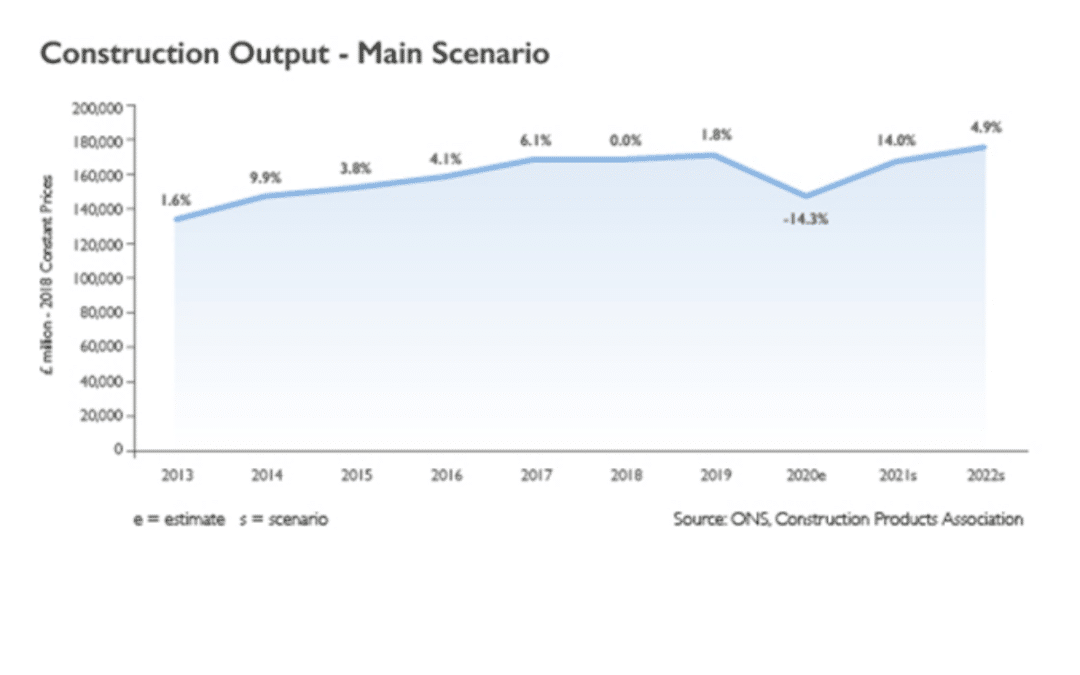
Construction output expected to rise 14%

Construction output expected to rise 14%

Construction bouncing back despite W-shaped recession and recovery

The CPA’s latest Construction Industry Scenarios sees a ‘W’-shaped economic recession and recovery as its main assumption, with construction output expected to rise 14% in 2021 and 4.9% in 2022. This takes into account the new lockdown restrictions over winter 2020/21 before a sustained recovery from 2021 Q2 as vaccines are rolled out and the services-based economy can reopen again. While some sectors of construction are dependent on consumer and business confidence returning, construction activity has largely been able to bounce back quicker than the overall economy.

FIS Members – access the full report here

With government making it clear that the construction and manufacturing sectors should continue to operate despite Covid-19 restrictions, output has been able to rise and recover relatively rapidly. The 14.0% rise in 2021 follows an estimated contraction of 14.3% overall in 2020 caused by the sharp fall in the first half of last year. It should be noted, however, that output is only expected to recover to pre-Covid levels in 2022. There is also the risk that once the furlough and self-employment support schemes end in April, there may be a sharp rise in unemployment that could potentially dampen this recovery.

The CPA’s Scenarios show that private housing was one of the quickest sectors to recover in 2020, with mortgage lending and property transactions above pre-Covid levels at the end of the year. Pent up demand as well as the government’s stamp duty holiday and the end of the first phase of Help to Buy largely drove the recovery in this sector. Demand for private housing is expected to moderate in 2021 after these policies end on 31 March and then subsequently pick up once again in line with the economic recovery throughout late 2021 and 2022.

A slower recovery has been seen in the commercial sector, with store closures and low rent collection in retail and leisure as well as the shift to working from home causing uncertainty for the offices sub-sector. Recovery in 2021 and 2022 is further constrained by the long-term shift to e-commerce in retail, which is likely to have been accelerated by consumers switching to online purchasing during the pandemic. The ongoing question of whether the shift to homeworking will continue after the vaccines are rolled out will be crucial to determining demand for offices space.

Homeworking has on the other hand had a positive impact on the private housing RM&I sector, with households investing accumulated savings from lower daily expenditure back into homes. Although the trajectory for future demand is dependent on labour market conditions as job support schemes end in April, the extension of the government’s Green Homes Grant may help to boost activity. For public housing, a backlog of cladding work is expected to drive activity in RM&I in 2021 and 2022 as the Building Safety Programme moves beyond the removal of Aluminium Composite Material.

Commenting on the Winter Scenarios, the CPA’s Economics Director, Noble Francis, said: “The spectre of a ‘No Deal’ Brexit that would have badly affected the UK economy and construction in the short term has been avoided but questions over the long term impact of Covid-19 on the structure of the economy still remain. This continues to leave questions about the fortunes of certain construction sectors. This is most notable in the commercial sector, where there is still lots of uncertainty about the future of retail and office space. It will be crucial to observe how businesses change their operations as the vaccine is rolled out in the coming months and to what extent there is a ‘return to the office’.

“While the fortunes of some sectors have been tied to Covid restrictions and associated business and consumer confidence in the wider economy, infrastructure has largely escaped such uncertainty. Projects have been able to effectively enact safe operating procedures given the sector’s large construction sites that have fewer different trades mixing than in most sectors. As such, infrastructure has been least-affected by Covid restrictions and output is expected to lift the whole industry over 2021 and 2022. Main works on HS2, Europe’s largest construction project, along with offshore wind and nuclear projects are expected to be the main drivers of activity.”

Call for assessors for the finishes and interiors sector occupations

Call for assessors for the finishes and interiors sector occupations

There is a demand for people with occupational expertise to become vocational and end point assessors for finishing and interiors occupations.  More colleges and independent training providers are now preparing to deliver apprenticeships and other training programmes for Dryliners, Ceiling Fixers, Partition Installers and Plasterers, people with experience are now required to pass on their skills and knowledge to the next generation of operatives.

 If you feel you have reached that point in your career when it’s time to give something back, vocational and end point assessment is definitely worth considering.  You will need good interpersonal, administrative and organisational skills and the more occupational experience you have the better you will be equipped to assess an individual’s skills and knowledge.  Being a part of people’s development and witnessing their success is very rewarding.  If you are interested please visit https://www.nwskillsacademy.co.uk/ or call 0161 442 4344.

George Swann FIS Skills and Training Lead said: 

“Becoming an assessor can be a secure and rewarding career choice and the opportunity to shape the next generation of talent.  It is a key role in the success of the sector, helping new entrants to gain their qualifications and become highly skilled in their trade.  This is a fantastic opportunity for experienced industry professionals to use their skills and knowledge in a new capacity and FIS encourage you to find out more.  The continuing shortage of skilled labour will not be address without good quality training and assessment”.

Further information can be found at

NOCN Level 3 Award in Assessing Competence in the Work Environment – NOCN and Become an End Point Assessor

https://www.cityandguilds.com/search?n=0&q=end+point+assessment&s=relevance

If you would like to talk through the requirements of this role contact the FIS by calling 0121 707 0077 or emailing info@thefis.org.  The success of new entrants to the sector and therefore the longevity of the skills is reliant on dedicated competent assessors.


Visit the Skills Hub

The hub provides information on sector careers, apprenticeships and funding, as well as access to e-learning, CPD and other training. It brings together details of courses specific to the finishes and interiors sector, making accessing and booking training quick and easy.

Government develops new video explainers on doing business with Europe

Government develops new video explainers on doing business with Europe

The Department for Business, Energy and Industrial Strategy (BEIS) has launched a series of new, on demand videos to help businesses familiarise themselves with the new rules and the actions they should take. Businesses can find out more about 18 topics, including importing and exporting, trade, data, and audit and accounting.  There is even some construction specific content.

List of video explainers

  1. Businesses Engaged in Emissions Trading
  2. Businesses Hiring Overseas Staff
  3. Businesses Involved in the Horizon 2020 Funding Service
  4. Businesses Involved with Data
  5. Businesses Operating Online
  6. Businesses Preparing and Auditing Financial Accounts
  7. Businesses who Import and Export
  8. Businesses Providing Services to EU Markets
  9. Businesses Shipping Waste between GB and EU
  10. Businesses Working with Intellectual Property
  11. Chemical Regulations
  12. Moving Goods into, out of, or through Northern Ireland
  13. Placing and Selling Goods on the Market
  14. REACH Chemical Regulations
  15. Recognition of Professional Qualifications
  16. Rules of Origin
  17. Trade Tariffs
  18. Businesses and Trade Agreements (not yet available)

Content is split into 12 sectors with Construction and Housing an option to help refine information and help save time trawling through.  Highlights include a video dedicated to Moving Goods into, out of, or through Northern Ireland and a simple introduction to Rules of Origin, which have been flagged as a potential stumbling block for companies in our sector.

Register now to immediately access the video content.

To access the FIS Brexit Toolkit including all the latest updates click here.

FIS welcomes new regulator established to ensure construction materials are safe

FIS welcomes new regulator established to ensure construction materials are safe

Residents will be protected through the establishment of a national regulator which will ensure materials used to build homes will be made safer, the Housing Secretary Robert Jenrick has announced today (19 January 2021).

The regulator for construction products will have the power to remove any product from the market that presents a significant safety risk and prosecute any companies who flout the rules on product safety.  This follows recent testimony to the Grenfell Inquiry that shone a light on the dishonest practice by some manufacturers of construction products, including deliberate attempts to game the system and rig the results of safety tests.

The regulator will have strong enforcement powers including the ability to conduct its own product-testing when investigating concerns. Businesses must ensure that their products are safe before being sold in addition to testing products against safety standards.

This marks the next major chapter in the government’s fundamental overhaul of regulatory systems. The progress on regulatory reform includes the publication of an ambitious draft Building Safety Bill, representing the biggest improvements to regulations in 40 years, and a new Building Safety Regulator that is already up and running in shadow form.

Housing Secretary Rt Hon Robert Jenrick MP said:

The Grenfell Inquiry has heard deeply disturbing allegations of malpractice by some construction product manufacturers and their employees, and of the weaknesses of the present product testing regime.

We are establishing a national regulator to address these concerns and a review into testing to ensure our national approach is fit for purpose. We will continue to listen to the evidence emerging in the Inquiry, and await the judge’s ultimate recommendation – but it is already clear that action is required now and that is what we are doing.

Business Minister and Minister for London Paul Scully said:

We all remember the tragic scenes at Grenfell Tower, and the entirely justified anger which so many of us in London and throughout the UK continue to feel at the failings it exposed.

This must never happen again, which is why we are launching a new national regulator for construction materials, informed by the expertise that already exists within the Office for Product Safety and Standards.

Chair of the Independent Review of Building Regulations and Fire Safety Dame Judith Hackitt said:

This is another really important step in delivering the new regulatory system for building safety. The evidence of poor practice and lack of enforcement in the past has been laid bare. As the industry itself starts to address its shortcomings I see a real opportunity to make great progress in conjunction with the national regulator.

Iain McIlwee, CEO of Finishes and Interiors Sector (FIS) stated:

Bad enforcement is worse than bad regulation as it tilts the market in the favour of the unscrupulous.  At the heart of FIS strategy is the FIS Product Process People (PPP) Quality framework, it is no coincidence that the first P is Product.  We welcome the new regulator and the principles set down in the Building Safety Bill and look forward to working with all involved in helping to lead improvements in quality and safety in the market.

The regulator will operate within the Office for Product Safety and Standards (OPSS) which will be expanded and given up to £10 million in funding to establish the new function. It will work with the Building Safety Regulator and Trading Standards to encourage and enforce compliance.

The government has also commissioned an independent review to examine weaknesses in previous testing  regimes for construction products, and to recommend how abuse of the testing system can be prevented.

It will be led by a panel of experts with regulatory, technical and construction industry experience and will report later this year with recommendations.

Firestopping of service penetrations: a new best practice guide

Provision of testing expanded to smaller employers where people cannot work from home

Supreme Court judgment in FCA’s business interruption insurance test case

In what may well be good news for some companies in the Finishes and Interiors Sector, The Supreme Court has substantially allowed the Financial Conduct Authority’s (FCA) appeal on behalf of policyholders. This completes the legal process for impacted policies and means that many thousands of policyholders will now have their claims for coronavirus-related business interruption losses paid.  The impact of this judgement on covering costs associated with the delay in start or abandonment of construction projects is yet to be fully uncovered, but below we explore what the judgement means and how to start assessing your policy.

Background

Many policyholders whose businesses were affected by the Coronavirus pandemic suffered significant losses, resulting in large numbers of claims under business interruption (BI) policies.

Most SME policies are focused on property damage and only have basic cover for BI as a consequence of property damage.   But some policies also cover BI from other causes, in particular infectious or notifiable diseases (‘disease clauses‘) and prevention of access and public authority closures or restrictions (‘prevention of access clauses‘). In some cases, insurers have accepted liability under these policies.  In other cases, insurers have disputed liability while policyholders considered that they had cover leading to widespread concern about the lack of clarity and certainty.

The FCA’s aim in bringing the test case was to urgently clarify key issues of contractual uncertainty for as many policyholders and insurers as possible. The FCA did this by selecting a representative sample of 21 types of policy issued by eight insurers. The FCA’s role was to put forward policyholders’ arguments to their best advantage in the public interest. 370,000 policyholders were identified as holding 700 types of policies issued by 60 insurers that may be affected by the outcome of the test case.

The High Court’s judgment last September resolved most of the key issues but, because we were unable to reach agreement, insurers and the FCA made ‘leapfrog’ appeals to the Supreme Court (without going to the Court of Appeal first).

What does the judgement determine

The Supreme Court judgment is complex, runs to 112 pages and deals with many issues. In summary, the FCA argued for policyholders that the ‘disease’ and ‘prevention of access’ clauses in the representative sample of 21 policy types provide cover in the circumstances of the coronavirus  (Covid-19)  pandemic, and that the trigger for cover caused policyholders’ losses.

The High Court’s judgment last September said that most of the disease clauses and certain prevention of access clauses (12 policy types from the sample of 21, issued by six insurers) provide cover and that the pandemic and the Government and public response caused the business interruption losses. The six insurers appealed those conclusions for 11 of the policy types, but the Supreme Court has dismissed those appeals, for different reasons from those of the High Court.

It should be noted that the judgment focussed primarily on policies where notifiable diseases were not specified.  It remains the case that the majority of business insurance policies specify covered diseases, with COVID-19 typically not included, and hence they do not provide cover for business interruption in respect of the Covid-19 pandemic. 

On the FCA’s appeal, the Supreme Court ruled that cover may be available for partial closure of premises (as well as full closure) and for mandatory closure orders that were not legally binding; that valid claims should not be reduced because the loss would have resulted in any event from the pandemic; and that two additional policy types from insurer QBE provide cover. This will mean that more policyholders will have valid claims and some pay-outs will be higher.

The FCA’s legal have published a bulletin on their website, which may be referred to for further detail.

What today’s judgment means for policyholders

This does open wider potential for claims within the Finishes and Interiors Sector as the judgment brings to an end legal arguments under 14 types of policy issued by six insurers, and a substantial number of similar policies in the wider market which will now lead to claims being successful.

The test case was not intended to encompass all possible disputes, but to resolve some key contractual uncertainties and ‘causation’ issues to provide clarity for policyholders and insurers. The judgment does not determine how much is payable under individual policies, but provides much of the basis for doing so.

Following the High Court’s judgment, insurers decided to pay claims on some policies and the FCA has asked insurers to progress claims on other policies that the High Court said provided cover so that they could be settled quickly following the appeals to the Supreme Court.

Each policy needs to be considered against the detailed judgment to work out what it means for that policy. Policyholders with affected claims can expect to hear from their insurer soon.

Next steps

In short, check your wording – if you have “disease clauses” or “prevention of access clauses” that referenced notifiable diseases without specifying the diseases which were covered and you can identify a quantifiable loss then you may be able to make a claim.  If this is the case, make contact with your broker and explore with them the potential and how to structure your claim.  Remember –  Policyholders with questions should approach their broker, other advisers or insurer.  Policyholders who remain unhappy following their insurer’s assessment of their claim may be able to refer their claim to the Financial Ombudsman Service, whose role is to resolve individual disputes.

If you need a second opinion or wish to discuss you clause/claim, please contact the FIS on 0121 707 0077 or sent outline details (including policy wording and an outline of what you believe you claim entitles you to) to info@thefis.org and we can arrange to have the policy reviewed.

The Supreme Court’s judgment will be distilled into a set of declarations. The FCA and Defendant insurers are working as quickly as possible with the Supreme Court to enable the Court to issue its declarations.

The FCA will publish a set of Q&As for policyholders to assist them and their advisers in understanding the test case. The FCA will also publish a list of BI policy types that potentially respond to the pandemic based on data that we will be gathering from insurers.

The FCA has published draft guidance for policyholders on how to prove the presence of coronavirus, which is a condition in certain types of policy. The consultation closes on 18 January, but the FCA is extending the closing date to 22 January only for any supplemental comments arising from the judgment. The FCA will issue finalised guidance as soon as possible after that.

The FCA will continue to keep policyholders appraised of matters as they progress, through its dedicated webpage.

Additional Information

The judgment is available on the Supreme Court’s website.

FAQs: Tariffs and Rules of Origin (RoO) in the UK-EU Trade and Cooperation Agreement

FAQs: Tariffs and Rules of Origin (RoO) in the UK-EU Trade and Cooperation Agreement

1) Can I export tariff free under the new UK-EU trade deal?

As of 1 January 2021, goods exported to the EU are eligible for zero tariffs if the goods meet the Rules of Origin requirements set out in the Agreement and have the right documentation. If not, the goods may be subject to EU tariffs.

The same applies for imports to the UK from the EU.

2) What are Rules of Origin?

Rules of Origin determine the ‘economic nationality’ of a good. They are a standard part of free trade agreements (FTAs).

Rules of Origin ensure that only goods produced in the countries party to the FTA (the UK or the EU) benefit from zero tariffs

3) How do I comply with Rules of Origin?

First, traders need to understand whether their good meets the applicable rules. To do this they need to classify the good to find its Harmonized System Code and then consider the relevant rules for that good. Traders can do this using this online tool.

Second, traders need to understand how to demonstrate origin to the customs authorities and what paperwork they need to include with the good when exported. Traders can self-declare goods meet the rules by making out a statement on origin. Alternatively, the importer can use importer’s knowledge, and traders may need to provide other information. Traders should look at the origin procedures in the text of the Agreement.

4) What if I am importing goods into GB and then (re-)exporting them to the EU?

The UK is no longer part of the EU Customs Union. This means that goods imported into GB cannot move freely between GB and EU Member States or vice versa. To be eligible for zero tariff export to the EU, these goods still need to comply with Rules of Origin. This means there must be some production in the UK. This applies to EU origin goods as well as to goods from the rest of world.

If traders move goods through GB from one EU Member State to another without the goods entering UK customs territory (i.e. without entering free circulation in GB), the goods may not need to meet Rules of Origin.

 6) Can I use a customs agent to help me with Rules of Origin? 

Yes. There is guidance available on how to find a customs agent.

Compliance remains ultimately the responsibility of the exporter.

7) Do I need a declaration from my supplier?

 If the goods you are exporting incorporate originating materials from a supplier, you may need a declaration from your supplier to meet Rules of Origin requirements.

Until 31 December 2021, exporters may make out statements on origin based on supplier’s declarations even if they do not have all the relevant supplier’s declarations in hand at the time they make the statement on origin. Exporters must be confident that the exported goods meet the Rules of Origin requirements and may be asked to retrospectively provide a supplier’s declaration after this date.

 8) Where can I go for more information?

For full Rules of Origin guidance on trading with the EU, go to: https://www.gov.uk/government/publications/rules-of-origin-for-goods-moving-between-the-uk-and-eu-

 You can visit the FIS Brexit Toolkit here.


An Hour to Skill – new resources developed by leading businesses to support personal development

An Hour to Skill – new resources developed by leading businesses to support personal development

The Department for Education has launched ‘An Hour to Skill’ campaign which aims to encourage employers and the nation to set aside just one hour a week for online learning by taking a free course from The Skills Toolkit.

Although this is primarily focused on encouraging people to develop for their next step in career progression, employers may wish to take advantage by using these free courses to train existing employees.  Statistics show 94% of employees stay at a company longer if there is investment in their individual career development.  At the time of writing there are nearly 90 courses available.

These high-quality, online courses aim to enhance individuals’ job prospects, giving them easy access to skills that could unlock job opportunities in a competitive market, or help them get ahead in their current role. The Skills Toolkit features more than 70 courses designed by some of the nation’s leading businesses and educational institutions including Amazon Web Services, Cisco, FutureLearn, Lloyds Bank, LinkedIn Learning, Microsoft, The Open University and many more.

Learn about:

  • practical maths
  • computer essentials
  • personal growth and wellbeing
  • professional development
  • business and finance
  • digital design and marketing
  • computer science and coding

The courses form part of the government’s Plan for Jobs, which aims to help boost the UK economy as it recovers from the impact of COVID-19.

FIS has created a dedicated resource to help companies within our sector source training. As well as our active network of Approved Training Providers, through the FIS you can access a range of Continual Professional Development (CPD) and eTraining to support development of people and demonstration of competence.

Visit The Skills Toolkit here


Welsh Consultation – Safer Buildings in Wales

Welsh Consultation – Safer Buildings in Wales

The Welsh Government has published its long awaited consultation on Safer Buildings in Wales. The documentation can be viewed here.

The White Paper sets out proposals for the comprehensive freeform of legislation that contributes to building safety in Wales. It focuses on legislative changes across the lifecycle of buildings aimed improving safety and minimising the risk of fire as well as setting out aspirations for cultural change in the way buildings are designed, constructed and managed.

The consultation proposes clear lines of accountability by creating new roles and responsibilities to those who own and manage relevant buildings. It will also provide a stronger regulatory system to hold those responsible to account. Residents will have enhanced rights and a stronger voice on matters affecting their homes.

The consultation closes on 12 April 2021. FIS will be responding to this consulation via the Construction Products Association, therefore members are encouraged to send their responses to joecilia@thefis.org by Monday 22 March 2021. We will then collate the feedback and submit a response to CPA.