0121 707 0077

National Apprenticeship Week – 3-7 February 2020

National Apprenticeship Week – 3-7 February 2020

‘Look Beyond’ has been announced as the theme for the 13th annual National Apprenticeship Week 2020 (the Week, NAW2020), taking place from 3 to 7 February 2020.  The week is run by the National Apprenticeship Service.  The ‘Look Beyond’ themed week will celebrate the diversity and value that apprenticeships bring to employers, apprentices and communities across England today. From highlighting the breadth of industries and roles available to the talent and energy apprentices bring into the workplace.

We urge all FIS Members and Approved Training Providers to let us know about any plans they have for the week and refer any stories/case studies that could help to promote the sector to the FIS team via info@thefis.org or call us on 0121 707 0077 so that we can incorporate into our activities. 

We have established an FIS Apprenticeship hub on our new website here that we will be developing in the run-up to the week.

Seven million and one reasons to change:  FIS to lead new taskforce to look at plasterboard ingress

Seven million and one reasons to change: FIS to lead new taskforce to look at plasterboard ingress

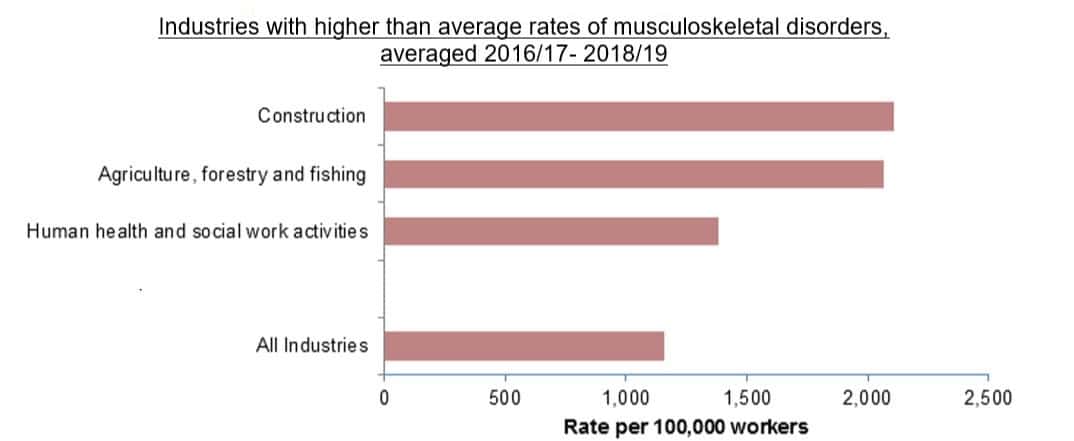
Approaching seven million workdays are lost in the UK due to Musculoskeletal Disorders every year with construction topping the naughty list. To combat this, The Health in Construction Leadership Group has set out its stall for 2020 with a plan to reduce musculoskeletal disorder in the sector. A specialist taskforce has been set up to look specifically at plasterboard ingress and this is to be chaired by FIS Technical Director Joe Cilia.
The Health in Construction Leadership Group (HCLG) was formed in 2014 after a challenge from the Health and Safety Executive’s (HSE) Construction Industry Advisory Committee (ConIAC) for the industry to do more to ‘Think Health’ and responding to the influence of ‘Construction 2025’, the Industry Strategy for Construction. The group is comprised of contractors, clients, HSE, professional bodies, trade associations and trade unions.

The taskforce is building on existing best practice guidance, but vitally also looking at the health and economic case for improvements in occupational health and how the supply chain can collaborate more effectively to understand the long term implications of poor sequencing and site lay-out and how designers can factor this thinking into their CDM responsibilities.

Work is being broken down into sections on Planning, Supply and Distribution, Delivery and Offloading, Storage, Vertical Movement, Horizontal Movement, Storage at Point of Installation, the Installation Operation itself, Storage of Off-cuts and Removal and Egress of Waste.

Joe Cilia stated “our aim is to develop a seminal report that will give us a roadmap to improve safety at each stage in the construction process, from procurement through to waste removal. In so doing we will reduce the risk of injury and improve productivity and working conditions for operatives on site. To achieve this we have brought together the supply chain and delivery teams to share best and good practice and make recommendations with health and economic outputs. Within this work it is vital that we consider not just the manual operations, but risks our decisions can create for others, ultimately how the wider construction operation and better sequencing and planning can reduce risk.”

Balfour Beatty, Chair HCLG MSD Task Group Occupational Health and Hygiene Specialist, Health team |HSES| Ian Strudley said ‘’more working days are lost in construction as a result of musculoskeletal disorders than any other single cause of ill-health. There is so much more that we could and should be doing to make sure that we keep people healthy in work and we better manage the consequence of any musculoskeletal ill-health that has been caused in and indeed out of the workplace. I am pleased to say that the Plasterboard Group has already done much to improve productivity and reduce ill-health from the movement and handling of plasterboard materials. These next steps looking at each stage of the construction process will help consolidate this effort to achieve further improvements in musculoskeletal health, and therein achieve additional risk reduction and greater productivity.”

Senior Policy Advisor, Health and Safety Executive Construction Health Team, Sue Brandrick said ‘’tackling work-related ill health is one of HSE’s priorities. There is particular focus on musculoskeletal disorders in sectors, like construction, where they are amongst the most common cause of sickness absence. This has a serious impact on the lives of sufferers, their families and the industry overall.

Working collaboratively and tackling the problem holistically is welcomed by HSE. This is a more effective approach compared to focusing on individual aspects in isolation. I am pleased to be working with HCLG in this area to reduce the health risks to construction workers from lifting, moving and handling large amounts of plasterboard”

FIS is calling for volunteers to support this group please email Joe Cilia to register your interest and find out more about the project (joecilia@thefis.org).
2020 is a CITB Consensus Year

2020 is a CITB Consensus Year

A proposed offer to industry stating what priorities CITB have identified in order to train and qualify the construction industry and how CITB levy will be collected for the next three years, 2021 to 2023, will be distributed in April 2020.  This is not a vote to retain or close CITB, that decision is a lot more complicated and involves the Minister of State and Parliament.  To ensure FIS members get a say in how much Levy CITB can collect from the construction industry you must ensure:

  1. You complete your CITB Levy return on time.
  2. You ensure you state you are a member of the Finishes and Interiors Sector at section 1A of the return.

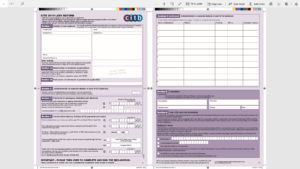
Here is an image of the 2019 Levy Return.  The 2020 Levy Return will have the same details but, will be a different colour:


Further guidance will be available from mid-March 2020 when the CITB proposed offer (the priorities for construction and levy collection) will be distributed via multiple means e.g. roadshows, online, websites and news media.  CITB will confirm to FIS the number of Levy paying employers and the value of their CITB Levy contribution.  The final amount of levy to be collected will be confirmed in CITB’s final offer during June or early July 2020, once the proposed plans are approved.

In order to provide information so that members can make an informed decision, FIS will produce a position statement in June 2020.  We will also be dealing directly with our Levy paying employer members and will have already been in regular contact with their Levy contact.  When issuing the survey, we will send this directly to our Levy contacts and the CEO, as we will expect the CEO to be responding to the question on behalf of the company. We do however expect the Levy contact to ensure the CEO has all the relevant information to allow them and their Board to decide on how the organisation should respond to the question.

Although it is yet to be confirmed, FIS will distribute the CITB consensus survey when it is available.  Your responses will be presented to the FIS Board in early to mid-September 2020.  The final response must be sent to CITB before the end of September 2020.  The Consensus Survey window will close on Wednesday 30 September 2020.

The two measures used to demonstrate consensus has been achieved using reasonable steps to consult will be:

  1. More than 50% of levy payers.

PLUS

  1. More than 50% of levy payable by employers that support the proposals (the value of what is to be collected)

Data from the 2017 Levy Consensus Results for Build UK:

Trade Associations

Levy Payable

FINAL TRADE ASSOCIATION TOTAL

26

£25,513,143

Yes

21

91%

£20,911,130

98.21%

No

2

9%

£381,218

1.79%

Abstains

2

N/A

£4,075,216

N/A

No Response

1

N/A

£145,580

N/A

 Please remember to ensure you have an opportunity to vote:

  1. You complete your CITB Levy return on time.
  2. You ensure you state you are a member of the Finishes and Interiors Sector at section 1A of the return.
IMPORTANT Balustrade Safety Alert from SCOSS/HSE/ICE

IMPORTANT Balustrade Safety Alert from SCOSS/HSE/ICE

This safety alert has been published by SCOSS the Standing committee on Structural safety who only send out this type of notice following an incident so its worth noting, especially where you are involved in installing glass as a barrier.

There is a lot to take in but in summary it covers.

  • The correct use of glass in balustrades
  • How to comply with BS6180:2011
  • The danger of glass slip and how to avoid bad practice
  • Installation awareness
  • The importance of the BSI Kitemark for compliance
  • The benefits of using proprietary/Standard systems.

Please ensure you share this with your teams,and do let us know if you need more clarity.

To download the full guidance note click here

FIS develops new guidance when installing partitioning to beams coated with intumescent paint

FIS develops new guidance when installing partitioning to beams coated with intumescent paint

In response to a number of questions related to installing partitioning to the underside of beams coated with intumescent paint, the FIS Drylining Working Group has reviewed current guidance and issued a new Technical Notice.

FIS Technical Director Joe Cilia said:  “Concerns have centred around the impact of fixing to the steel work and the impact that this might have on the ability of the intumescent paint to react and protect the steel work, and therefore any warranty provided by the paint manufacturers. In response to this we have worked with manufacturers, contractors and experts from across the sector to develop a new guidance note.  We would encourage all members to review and ensure that this approach is reflected in their current working practices.”

Members only content – log in here or join us here

Installing partitioning to the underside of structural beams coated with intumescent paint


FIS issues guidance to address the risks of HAVS

FIS issues guidance to address the risks of HAVS

FIS Technical Engagement Manager Nigel Higgins has produced a new guidance note with help from FIS member Veitchi to address the risks of Hand Arm Vibration Syndrome (HAVS).

The guide explains the syndrome, how to measure the vibration magnitude of the tool, and convert that into a point score which is compared against the daily exposure time.

This methodology assisted Veitchi in recognising the risk and leading to purchasing new machinery which improved production as well as providing a safer method of work.

This article which appeared in Construction Enquirer highlighted the real consequences  of ignoring the risk after a contractor was fined £600,000 after five employees developed Hand Arm Vibration Syndrome.

An HSE investigation found the company failed to assess or manage the risks associated with vibrating tools.

It also failed to provide suitable training or health surveillance for its maintenance workers and failed to maintain and replace tools which increased vibration levels.

Using the new FIS guidance really can save you money it seems.

The guide is available here.

CITB releasing new training standards

CITB releasing new training standards

In April 2020, CITB is releasing new training standards for short duration courses available to levy payers. Short duration courses are between half a days training and up to 29 days maximum.

Each of the standards will have grants attached for CITB levy paying companies.

For reference the following tiers hold the following values:

Tier 1 = £30 per delegate

Tier 2 = £70 per delegate

Tier 3 =£120 per delegate

If you need any assistance in claiming your CITB grant funding please contact the FIS Skills team on skills@thefis.org

See the new release standards available

Wales bans combustible cladding on high-rise buildings

Wales bans combustible cladding on high-rise buildings

The Welsh Government has today announced the banning on the use of combustible cladding on high rise buildings as from 13 January 2020. This will apply to all new residential buildings (flats, student accommodation and care homes) and hospitals that are over 18m high. The ban covers the entire height of the building and will apply to the complete wall assembly and certain attachments to the external wall including balconies and solar panels.  The ban will also apply to existing buildings where relevant building work is being carried out that falls within the scope of the Building Regulations, unless the building works have started on-site or an initial notice, building notice or full plans have been deposited and work has started on site within a period of 8 weeks.

The Welsh Housing Minister, Julie James, will publish a White Paper in 2020 setting out more details, FIS is working to avoid the repeat of problems that have impacted members in England.  To view the announcement click here.

Queen’s Speech – significant investment in infrastructure and housing, a focus on workers rights and building safety

Queen’s Speech – significant investment in infrastructure and housing, a focus on workers rights and building safety

The Queens Speech sets out the intent of Government over the next 12 months, attempts to lock in manifesto promises and sets out the stall of our new Government.  Probably few have been more significant than yesterday with everything at stake.

At a macro level getting Brexit done by implementing the Withdrawal Bill and fixing the exit date top the bill, but there is a fair bit in there for businesses operating in the construction sector.  In terms of specific policies related to construction we saw:

Investment in infrastructure and Housing

  • Commitment to invest £100bn in infrastructure and improved Broadband coverage across the UK
  • Funding to build 40 new hospitals in the UK in the next decade (over and above the refurb of 20 announced earlier in the year)
  • On Housing there will be continued support for first time buyers to address housing affordability, improvement to shared ownership models and renewal of the Affordable Homes Programme.  The Government is committed to building 1 million more homes.  Further improvements to the Planning Process are also promised.
  • The new £10bn Housing Infrastructure fund will be used to provide the roads, schools and GP Surgeries needed to support new homes.
  • To help improve quality Government will also legislate to require that developers of new build homes must belong to a New Homes Ombudsman.

Employment and Business Responsibility

  • Confirmation of the implementation of an Australian style points based immigration system post Brexit
  • Increases in R&D Tax Credits to 13% (see details of our webinar on how you can claim them here)
  • The introduction of a new Employment Bill that introduces a new enforcement body and enhance workers rights, support flexible working allow workers to ask for a more predictable contract and extend unpaid carers entitlement to leave.
  • Government will introduce new measures to reduce the disability employment gap.
  • Tighten company auditing an reporting to help improve public trust in business and help workers employed by large companies understand how resilient it is
  • Clamp down on late payment more broadly and strengthen the powers of the Small Business Commissioner to support small businesses that are exploited by their larger partners
  • Increase National Insurance Threshold to £9,500 and the National Living Wage to 2/3 the median wage (this is caveated by providing economic conditions allow).  Plans to lower the age of National Living Wage to 21 from 25 were also included.
  • The Government has committed not to raise income tax , VAT or national insurance
  • The Establishment of a National Skills Fund to improve investment in education
  • Reform Business Rates, bring forward the next re-evaluation and ensure that these are more frequent

Skills and Training

  • The bring renewed focus to further and technical education Government has pledged an extra £400 million for 16-19 year-old education next year, an increase of 7 per cent overall in 16-19 year-old funding and the biggest injection of new money in a single year since 2010.
  • There will also be additional investment in T Levels, supporting continued preparation for these courses with the first three starting from September 2020.
  • The Government will invest an additional £3 billion over the course of this Parliament to support the creation of a ‘National Skills Fund’.
  • The Government will invest £1.8 billion over five years in a rebuilding programme to upgrade the entire further education college estate.
  • The Government are also planning to establish 20 Institutes of Technology across England- unique collaborations between further education colleges, universities, and employers –– offering higher technical education and training in science, technology, engineering and maths subjects, to give people the skills they need for key sectors such as digital, construction, advanced manufacturing and engineering.

Sustainability

  • Re-affirmation of support for net zero carbon by 2050 and confirmation that they will enshrine in law environmental principles and legally binding targets

Building Safety

Perhaps most significantly of all a new Building Safety Bill that will implement the recommendations of Dame Judith Hackitt’s review of the Building Regulations.  Key elements of the Bill will include:

  • Providing clearer accountability and stronger duties for those responsible for the safety of high-rise buildings throughout the building’s design, construction and occupation, with clear competence requirements to maintain high standards.
  • Giving residents a stronger voice in the system, ensuring their concerns are never ignored and they fully understand how they can contribute to maintaining safety in their buildings.
  • Strengthening enforcement and sanctions to deter non-compliance with the new regime, hold the right people to account when mistakes are made and ensure they are not repeated.
  • Developing a new stronger and clearer framework to provide national oversight of construction products, to ensure all products meet high performance standards.
  • Developing a new system to oversee the whole built environment, with local enforcement agencies and national regulators working together to ensure that the safety of all buildings is improved.

In a separate Fire Safety Bill, the Government will ensure that building owners and managers are clear that they are responsible for assessing the risks of external walls and fire doors in buildings of any height.

You can download a fully copy of the Queens Speech here