by Nicky Smith | 5 Jul, 2017 | Main News Feed
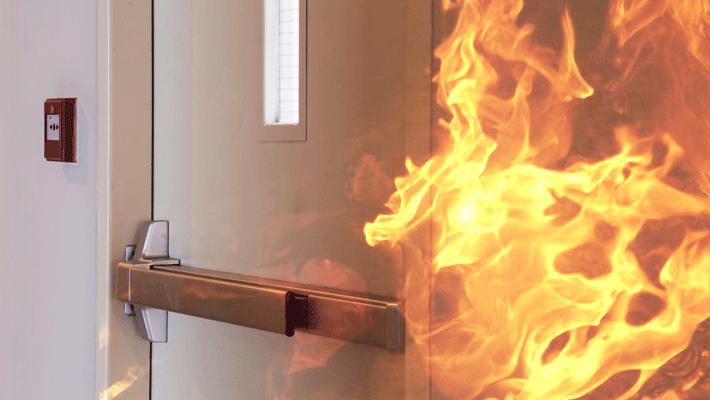
Three weeks after the devastating Grenfell Tower fire, we bring you a round-up of the week’s industry responses. A research briefing paper from Parliament.co.uk sets out the events and commentary around the Grenfell Tower fire, the relevant building regulations, fire safety laws and housing standards, the Government response to the fire, the responsibilities around re-housing, and previous concerns raised by fire regulations.
Landlords are engaging in a checking and testing process for Aluminium Composite Material (ACM) cladding. The tests that are currently being conducted at BRE – on behalf of the Department for Communities and Local Government (DCLG) – are a screening test to identify which ACM panels are of concern.
ACA is an Association that represents architects’ private practices in the UK. As publishers of Forms of Appointments and Building Contracts the ACA has a long and special interest in successful design, procurement and construction. Its response asks if the Design and Procurement of buildings in England and Wales are currently working as it should? If not, how can it be improved to prevent future catastrophic failures? The ACA sets out 41 relevant questions following the disaster.
The International Institute of Risk and Safety Management provides the open letter to the Prime Minister from over 70 leading organisations and figures from the UK’s safety and health profession. They call for a political sea change in attitude towards health and safety regulation and fire risk management following the Grenfell tragedy.
The Scottish Government reported that the second meeting of a Ministerial Working Group, convened to examine building and fire safety regulatory frameworks, has taken place. The group oversees a review of building and fire safety regulatory frameworks with an initial focus on high rise domestic buildings.

by Nicky Smith | 4 Jul, 2017 | Main News Feed
A summary of June’s data from the IHS Markit/CIPS UK Construction PMI® revealed that the UK construction sector recovery lost momentum in June.
Other key findings include:
-
- Business activity growth slows from May’s 17-month high
- Weaker rises in new orders and employment
- Business optimism eases to its lowest so far in 2017
To view the full report, click here.

by Nicky Smith | 30 Jun, 2017 | Main News Feed
After a 12-month period full of surprises, I guess it shouldn’t really have come as a surprise to find that we now have a period of political uncertainty to add to the general uncertainty generated by Brexit.
They say you get the politicians you deserve, but, really, are we this bad? Two prime ministers in a row have, through a combination of arrogance, contempt for the electorate and ineptitude, plunged the UK into an uncertain future. A hung parliament effectively erases the Conservative Party manifesto of any of the contentious policies such as social care – the so-called dementia tax – and will see them replaced with bland DUP-approved policies that do not upset one side in Northern Ireland.
In June 2016, we were looking at a period of sustained growth and had a stable, if flawed, relationship with our nearest neighbours and biggest market in the EU. All that the majority of business leaders had to consider was their investment plans for the future: should we build that new factory, invest in new technology or hire additional staff?
Now, 12 months later, the abiding sentiment in the business community is one of uncertainty – and uncertainty is the enemy of investment decision-making.
Doing a deal with the DUP may be politically expedient but it comes at the risk of unravelling the delicate balance that is politics in Northern Ireland. The leader of the Scottish Conservative Party, Ruth Davidson, has said that she puts country and her beliefs before the party. If only Mr Cameron and Mrs May had done that instead of carrying out their opportunistic referendum and election gambles, both of which spectacularly backfired.
So, what now for Brexit? Hard, soft or open? One thing became evident during the election campaign that was called to give Mrs May a mandate for a Brexit deal: the government clearly has no idea what a post-Brexit UK will look like. We were left with banal clichés such as “no deal is better than a bad deal”.
Far from being “bloody difficult”, our prime minister just looked inept and over confident. She completely handed the initiative to the EU negotiators by triggering Article 50 to set the two-year deadline, then calling and losing her majority in the election.
At the time of writing, negotiations are shortly due to start on Brexit. Is it possible to imagine a worse run-up to those negotiations? Unsurprisingly, the Europeans are scratching their heads about what we want.
Despite all of that, the UK remains a great place to do business and invest. Where else in the world can you find a fair legal system, a skilled workforce, a good banking system and an openness to foreign investment? I would add a stable political system, as chaotic as it currently appears.
So, there is something to look forward to, provided the politicians can start to make progress on the Brexit negotiations.
Find July’s SpecFinish on the Publications section of our Membership Hub here
by Nicky Smith | 29 Jun, 2017 | Main News Feed
FIS Skills is pleased to announce that Phase Two of the FIS Skills Partnership and Approved Training Provider Network launched earlier this week.
We are working to attract over 2,000 new entrants into our sector by 2020, with a view to having a sustainable model in place to bring in a further 1,500 new entrants per annum from 2020 onwards. To do this, the delivery team must have a full network of FE Colleges and Approved Training Providers across England, Wales and Scotland.
The Phase Two launch will obtain greater coverage and growth for the FIS Skills programme, helping us to address the skills shortage.
To find out more about joining the Partnership, visit the Skills Hub here.
Download the press release here.

by Nicky Smith | 28 Jun, 2017 | Main News Feed
NBS and the CPA have together launched a survey to understand construction product manufacturers’ views on BIM. For the last seven years, NBS has published its National BIM Report, focusing on the use and adoption of BIM among the design community; this first national survey seeks to uncover the use of and attitudes towards BIM among the construction product manufacturer community.
Developed in partnership with the Construction Products Association (CPA), which represents the UK’s manufacturers and distributors of construction products and materials, the survey will also look into manufacturer views on a range of BIM related topics including: attitudes towards BIM, thoughts on its adoption and maturity, as well as the 2016 mandate.
The survey is open until 23 July 2017 and there are prizes on offer. Respondents can complete the survey here and FIS will be able to share the results with our members.
FIS has a Special Interest Forum for BIM, visit the page here.
by Nicky Smith | 28 Jun, 2017 | Main News Feed
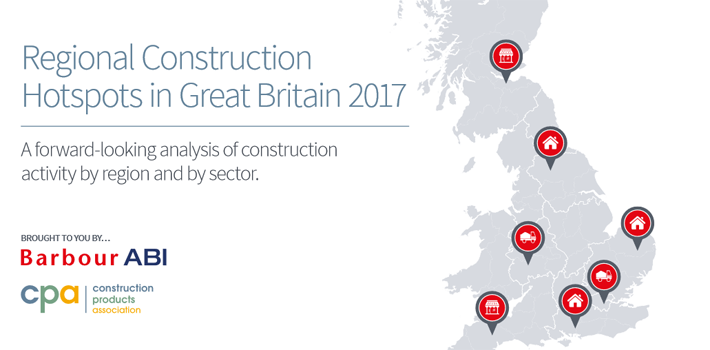
Barbour ABI has teamed up with the Construction Products Association to produce the Regional Construction Hotspots in Great Britain 2017 report.
Barbour ABI and the Construction Products Association have analysed construction activity by region and sector in 2016, with the majority of the work taking place in 2017 onward.
The report highlights regional construction contract value ‘hotspots’ and ‘coldspots’ for last year’s commissioned work in residential, commercial and infrastructure sectors.
Activity seems to be shifting away from London and the South East, with only two London regions making it into the top ten districts for construction contract value.
To download the report please click here.