by Oscar Venus | 5 Dec, 2025 | Main News Feed, Sustainability
Draft primary legislation for Carbon Border Adjustment Mechanism (CBAM) was published in April 2025 for technical consultation. At Budget 2025 government announced that indirect emissions associated with the production of CBAM goods will not be included in scope of CBAM at its implementation on 1 January 2027. Their inclusion in CBAM scope will be delayed until 2029 at the earliest. This is to reflect continued support for the Energy Intensive Industries (EII) Compensation Scheme
CBAM is effectively a new tax aimed at reducing carbon emissions. It will impact companies importing (and potentially exporting to the EU) and specifying products made with aluminium, cement, iron and steel (it is likely to be extended to cover other products such as glass in the future).
CBAM imposes a carbon cost to ensure imports face a comparable carbon price to goods produced domestically. This mechanism is designed to prevent “carbon leakage,” where companies might relocate production to countries with less stringent emissions regulations. .
The UK CBAM will come into force on 1 January 2027 and will apply to businesses importing £50,000 or more of CBAM goods over a 12-month period.
The UK government has published Finance (No.2) Bill 2025-26 on the UK Parliament Bills website. This includes the primary legislation for CBAM which you can find here. To download a copy of the Bill, click ‘Get file’ in ‘Bill 342 2024-25 (as introduced)’.
CBAM primary legislation can be found at Part 5:
Clauses 139-155 (pages 147-159)
Schedules 15 – 18 (pages 471-506)
Further changes may arise as a result of Parliamentary scrutiny, but the deadlines are likely to stand and it is vital that companies start understanding the potential costs and how this may impact upon estimates for future projects. Companies importing directly are recommended to look at any requirements that may be imposed on them. Contractors who may be preparing tenders for projects that run past 1st January 2027 should be speaking to their suppliers about any potential additional costs that CBAM might place on their project
You can find more information on CBAM in the Factsheet here.
by Clair Mooney | 12 Nov, 2025 | Sustainability
In a major step forward for the circular economy in commercial fit-out, the
FIS Project Reuse Scheme is supporting the reuse of high-quality ceiling tiles and luminaires from Rathbone Place to Broadgate, two landmark London developments.
The initiative sees Ambit, part of the Workplace Futures Group, carefully strip out and recover bespoke SAS ceiling tiles and LedLuk luminaires during its refurbishment works at Rathbone Place.
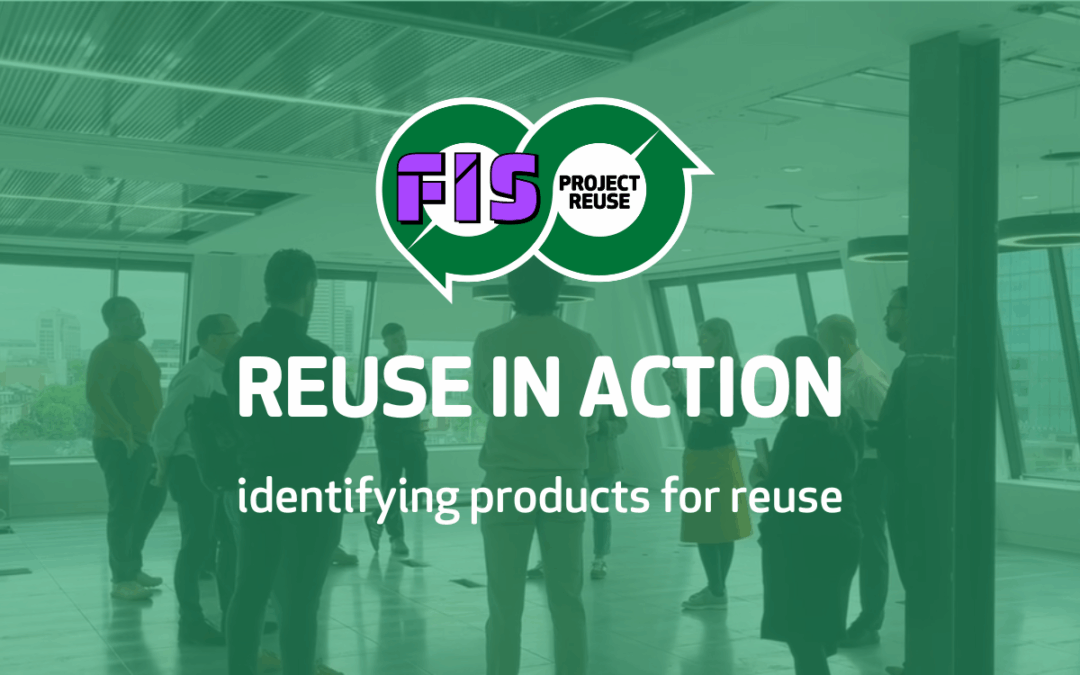
Video footage is being captured to document the different phases of the project – comprising the identification of suitable products for reuse, strip-out, preparation, and transfer of the materials.
In the first of our video series, Reuse in Action, we look at how the existing materials were identified as being suitable for reuse and the strip-out process as well as logistics and timescale for a successful transfer. We speak to British Land and Ambit on their reasons for reuse and how schemes like Project Reuse support a better circular economy.
As this reuse journey continues, we will bring you more footage of the project focussing on the movement of products between the two live sites and the re-installation in Broadgate. You can keep up to date with the project at www.thefis.org/project-reuse-case-study
Hattie Emerson, Project Manager for Project Reuse said:
This case study provides a transparent, real-world view of how reuse can be achieved safely, efficiently, and collaboratively across live projects, demonstrating how design, logistics, and sustainability can align across multiple organisations.
You can find out more about Project Reuse at https://www.thefis.org/knowledge-hub/sustainablility/reuse/ and keep up to date with the transfer of materials at www.thefis.org/project-reuse-case-study
by Clair Mooney | 26 Sep, 2025 | Main News Feed, Skills, Sustainability
FIS is supporting The Future Skyline Skills Commitment to encourage built environment employers to offer more inclusive workplaces and training, especially green skills training, to attract and retain new talent, including young people aged 16-18.
The construction industry is about people, progress, and possibility. This commitment, developed by the City of London Corporation and the Skills for a Sustainable Skyline (FSSC) Taskforce, empowers us to shape a
sector that is sustainable, inclusive and future-ready.
Iain McIlwee FIS CEO and Skills for a Sustainable Skyline Strategy Board Member said:
The Skills Shortage is a systemic problem that is impacting the market now and has the potential to choke expected future construction. The City of London Corporation recognise that this in turn has the potential to impact the attractiveness of London as leading global business hub.
The scale of the problem is enormous and particularly acute in London that was more reliant on migrant workers than other parts of the UK. The supply chain, from supplier and contractor through to client, needs to work together to create the right conditions to invest and work collectively to ensure we are finding the next cohort of workers now, have a stable pipeline of people wanting to join the industry in the future and the training infrastructure to deliver this. It has been amazing to work on the Skills for a Sustainable Taskforce Leadership Taskforce, I have learned loads, made amazing connections and found new hope. I applaud the City of London Corporation for creating this Taskforce and the collaborative ecosystem that is now working to support our common goal of fixing the skills crisis in London and look forward to being part of the next stage of the work – delivering it!”
To launch the Future Skyline Skills Commitment, The Skyline Skills Hub is hosting an in-person launch reception on the evening of Wednesday 1 October from 18.30-19.15pm (with networking before and afterwards), hosted at NLA’s The London Centre (3 Aldermanbury, London EC2V 7HH. Iain McIlwee will be attending the launch event, and is encouraging members to join him and hear about the commitment and how it can drive change in the sector, promoting sustainability and inclusivity by inspiring companies to take practical actions to address the sector’s skills gap.
by Clair Mooney | 26 Sep, 2025 | Sustainability
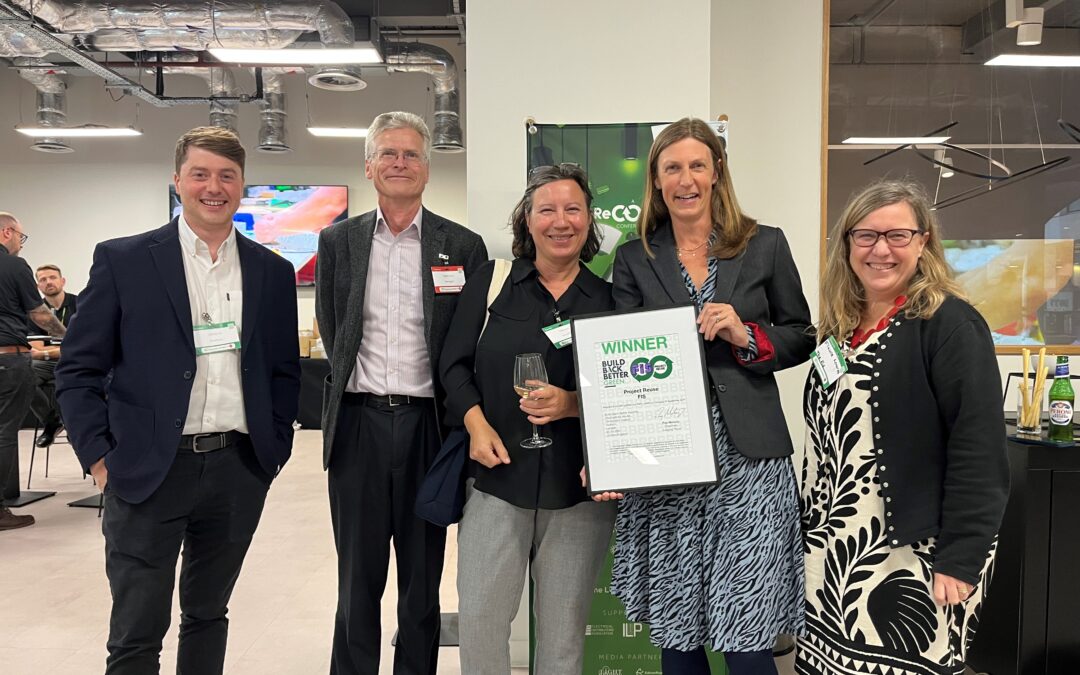
In an inspiring testament to innovation and sustainability, our ambitious initiative, Project Reuse, aimed at rescuing lights and other products from strip-outs has been awarded a Build Back Better GREEN Award in the 2025 lighting category. This award highlights our commitment in addressing the environmental challenges associated with fit-out and refurbishment.
The initiative, which has been crowdfunded for the first 12 months and led by the FIS Sustainability Leadership Group, focuses on the recovery and repurposing of lighting fixtures and ceilings products that are typically discarded during building strip-outs. By diverting these materials from landfills and giving them a second life, Project Reuse not only reduces environmental impact but also promotes a circular economy.
There is an increasing pressure from clients to reduce the carbon emissions of buildings. Giving products a second or third life is the only way we can continue our activities while minimising our impact on the planet. This is the way forward for the industry.
FIS Project Reuse Project Manager, Hattie Emerson who collected the Award said:
“We are thrilled to receive this award, which recognises our efforts to demystify the perceived challenges of incorporating preused products in projects. It is a result of dedicated collaboration, working closely with industry partners, architects, contractors, installers, manufacturers and sector leads to ensure the effective recovery and reuse of lighting and ceiling products. A special thanks go to the FIS Sustainability Leadership Group and project supporters Recolight, Reusefully, Ambit, Lumybel, Blackstone Strip Out, TP Bennett, Space Interior Systems, SAS, Recolight, Overbury and BPC Interiors without whose support this wouldn’t have been possible”.
The FIS Sustainability Leadership Group is a unique multi-stakeholder group that aims to accelerate sustainability through collaboration. We invite you to come and join the group whether you know a lot or very little about sustainability. If you are interested in joining the group, email flavielowres@thefis.org
You can find out more about Project Reuse here.
by Clair Mooney | 2 Jun, 2025 | Sustainability
Project Reuse, our innovative pilot scheme, has reached an exciting milestone with the first donated fit-out products arriving at the scheme’s East London storage facility. Designed to reduce embodied carbon emissions and waste from the commercial office fit-out cycle, the project is now proving that a scalable, practical model for reuse is not only possible but already underway.
Deconstructed by KpH Deconstruction and transported by Urban Miners, the materials are now safely stored as part of FIS’s pilot to explore the logistics, standards, and business models that will be necessary to scale reuse across the sector. With commercial office spaces refitted on average every five to seven years, there is significant potential to shift away from a linear ‘take-make-dispose’ model, towards a system where products retain their value and contribute to low-carbon construction strategies.
This initial delivery includes high-quality SAS130 ceiling tiles salvaged from a recent refurbishment project and marks a major step towards creating a truly circular approach in commercial interiors. The ceiling tiles, around 840 in number (covering 420m²), represent a value of £15,000 and an embodied carbon saving of around three tonnes of CO2. These nearly-new components, typically discarded despite being installed only briefly in Cat A fit-outs, are now being catalogued, stored, and prepared for reuse in future projects.
“There is growing appetite for reuse of products in commercial projects,” says Hattie Emerson, Project Manager at FIS. “The challenge is creating a system that gives project teams the confidence that reused products will be available, in the right condition, at the right time. The Project Reuse pilot scheme is paving the way by testing the processes and infrastructure that will make that possible.”
Lyndsey West, Managing Director of KpH Deconstruction, added
“Increasing construction material reuse requires a collaborative effort across the industry. We need to move to a point where circular practice becomes commonplace and redefines construction norms. We’re pleased to be working with FIS on this pioneering project to advance reuse and keep these quality materials in circulation.”
The donated materials were identified through a pre-demolition audit, a process which FIS is keen to see more widely adopted, particularly pre-refit. While materials often make their way to the charitable sector, commercial reuse remains a missed opportunity. This pilot aims to create the systems, standards and trust needed to embed reuse into the heart of the commercial fit-out process.
To find out more about the scheme visit https://www.thefis.org/knowledge-hub/sustainablility/reuse/ or to arrange a donation or source a reuse product contact Hattie Emerson – reuse@thefis.org

by Clair Mooney | 22 May, 2025 | Sustainability
FIS has been working closely with the Supply Chain Sustainability School for over three years now. Together they have organised several webinars to showcase the great sustainability initiatives of the fit-out sectors. Topics have included reuse, circular economy, organisational carbon reporting or modern slavery. The Supply Chain Sustainability School has a huge amount of online resources which are freely available.
A couple of years ago, FIS members helped create a short e-learning course “An introduction to sustainability”. This course is aimed at those in our sector that have no or little knowledge of sustainability, but are keen to know more. Those that attend the course can be rewarded with CPD points.
More recently, the Supply Chain Sustainability School has been working on a tool to better assess the industry’s capability in sustainability. This new assessment is based on what the company is doing in sustainability rather than their knowledge. We would like to encourage our members to use this tool. The plan longer term will be to use the tool to map our collective journey to net zero and help members benchmark their own efforts.
You can start your sustainability journey by registering with the Supply Chain Sustainability School to access lots of great resources (register here – Supply Chain Sustainability School). You can also assess your company’s capability here and calculate your organisational carbon footprint with this free tool, here: FREE carbon calculator for supply chains – Supply Chain Sustainability School
Visit the FIS Sustainability Toolkit for a full update on the work of FIS in this vitally important area.