0121 707 0077

CITB funding crisis hits Employer Networks

CITB funding crisis hits Employer Networks

Members will be aware of the recent changes to CITB funding arrangements for training and development across the sector.

CITB has now provided a further update and clarification, specifically regarding funding for Employer Networks.

Full details of the update, including guidance on eligibility and next steps, can be found below:

“Following recent articles that have been published, we wanted to ensure that the correct information is being shared.

It is incorrect that CITB has stopped taking all bookings for training and we have not said there is no more money for training courses. Employer Networks are a budget-led initiative and due to the significant increase in uptake, our current budget for this financial year is fully committed and therefore we cannot accept training for bookings between 20 February and 31 March. Training can be booked that takes place after 1 April and any training that is already booked in ahead of 1 April will continue as planned.

We understand that this news may be frustrating for some, but we do see it as a positive that we have supported more employers with their training needs.

We continue to support plant and scaffolding training, apprenticeships and other key courses through our grants scheme. Further to this there are a number of free courses and resources that are available through our various funded projects.

We would also like to address the comments about our reserves. It has been published that CITB reserves are currently sitting at £78.9m – this figure is from our Annual Report and Accounts published in December 2025 and demonstrates the reserves as of March 2025. As a charity and Arm’s-Length Body we are required to maintain a minimum reserve level of £50m. CITB expects to be close to its reserves policy floor of £50m by 31 March 2026.”

Update: Employer Networks bookings and CITB Reserves – CITB

If you have any queries or questions, please reach out to Beena Nana or Marie Flinter

Earning, Learning, Progressing: Harrison’s Apprenticeship Journey

Earning, Learning, Progressing: Harrison’s Apprenticeship Journey

National Apprentice Week 2026: Case Study – DSP (Interiors) Ltd

One of the biggest challenges facing our industry is the recruitment of young talent. We’re proud to share how apprenticeships are helping to develop skilled fitters and strengthen the future workforce.

Employer perspective

We currently employ 21-year-old Harrison, who is undertaking an Interior Systems Installer Level 2 apprenticeship, trained through GTFS Ltd with funding support from CITB. From the outset, Harrison has demonstrated a strong work ethic and a genuine desire to learn, both of which have contributed positively to his development and our wider team.

Harrison has been making good progress in both his coursework and practical learning. He engages well with his on-site mentor and works closely with his assessor, ensuring that the link between training and real world application is consistently maintained. We are particularly pleased with the way Harrison applies his learning on site, translating theory into practice with growing confidence and accuracy.

Apprenticeships have proven to be an effective way for us to nurture talent and build skills aligned with our company standards and values. By investing in apprentices, we are not only developing capable individuals but also supporting long term workforce planning. Growing our own talent helps secure the future of our business and the wider industry.


 Apprentice perspective

Harrison chose the apprenticeship route because it allowed him to gain hands on experience while working towards a recognised qualification. The ability to earn while learning appealed to him and provided a practical pathway into the industry. This practical application has helped reinforce his understanding and build confidence, enough so that he will be taking part in the SkillBuild 2026 competition in the drylining category.

Reflecting on his experience so far, Harrison said,

“The apprenticeship has been a really good opportunity for me. I’ve learnt so much already working alongside a team of experienced fitters and have been able to build my confidence as I pick up new skills. The support from my mentor and assessor has helped me understand what’s expected and improve as I go.”

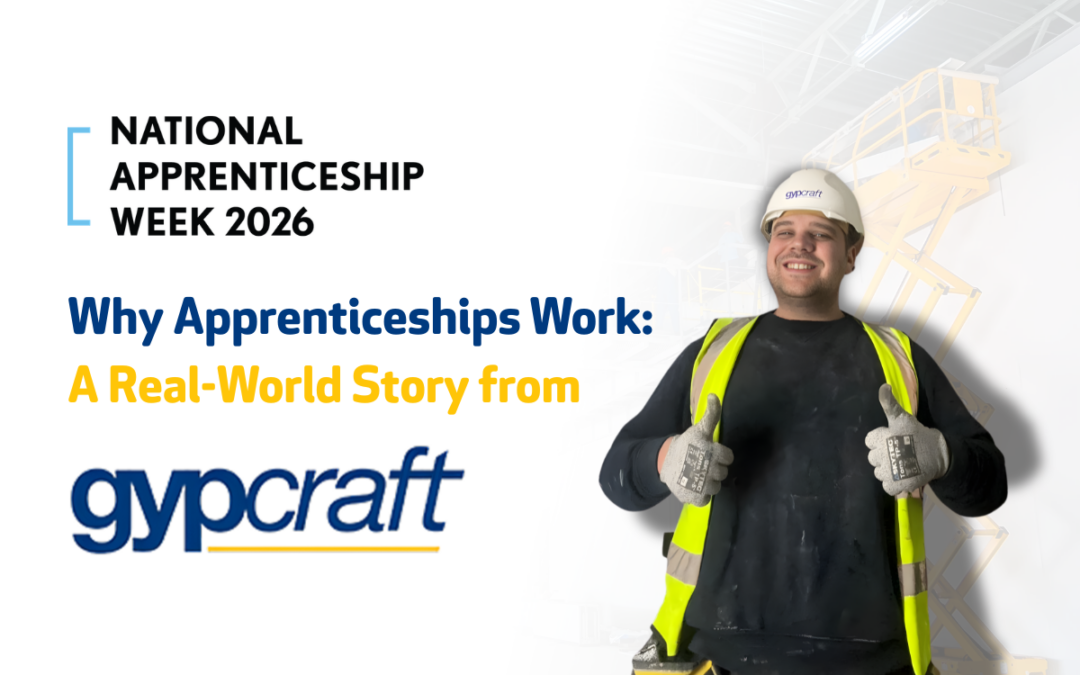
Why Apprenticeships Work: A Real-World Story from Gypcraft

Why Apprenticeships Work: A Real-World Story from Gypcraft

Employer’s perspective

Ryan is one of our Level 2 Interior Systems Installer (Drylining) apprentices, currently working on a residential project in Tunbridge Wells. He joined Gypcraft in 2025 after completing a Skills Bootcamp in Interior Systems delivered by British Gypsum and Construction Skills People in partnership with FIS.

The bootcamp allowed us to meet motivated candidates with a grounding in the trade. After an interview, site exposure, and a short work placement, positive feedback from our site team confirmed Ryan’s potential, and he began his apprenticeship in July 2025.

Programmes like this are invaluable in a competitive labour market, helping businesses connect with people seeking long-term careers while bridging the gap between training and employment.

Our training provider, MT Training, supported the process with clear communication, smooth enrolment, and flexible delivery. Their online platform tracks progress, while blended learning supports development on and off site.

Apprentices bring energy, enthusiasm, and pride to the team. Apprenticeships remain a vital investment in the future workforce.

Employee’s perspective

Becoming an apprentice with Gypcraft has had such a strong impact on my life, both work and personal. After working in hospitality for 10 years it has been such a positive change to have more structure in my day to day. I have learnt so much more than I realised I would have needed to, I’m also getting in better shape from having a physical job which is a great bonus.

To be able to earn a wage while gaining knowledge and a qualification is fantastic, it’s given me an opportunity I never would have been able to take if not for being paid to work, and earning a qualification that will make me a skilled tradesman while doing so will open so many doors for me in the near future, this is such a fantastic opportunity to have. It gets me prepared for the future and is giving me every opportunity to excel in my new trade.

Interacting with other dryliners is a big positive to the job, getting knowledge from individuals in the same field as you is a great way to stay on top of work and improve skills.

Becoming an apprentice has been a great change for me, having a regulated schedule has helped me get a better sleeping schedule, become more active, and also experience a new environment in work. The positive effects this has had for both my mental and physical health are invaluable.

After 7 months on this course it’s incredibly satisfying seeing my knowledge grow and turn into real work, I am now able to work for the most part unaided, but always have people around me that I can talk to and ask about any inquiries I may have. I can now look at plans and picture how the flat will look once constructed, it’s very satisfying to build something from nothing.

As the months go by I feel myself becoming more confident and quick, whether it’s measuring/cutting the metal studs, or cutting and installing drywall, this apprenticeship is helping me grow and improve dramatically

This experience has exceeded my expectations, the support from everyone at Gypcraft has been amazing, both on site with my manager who always checks in and tries to work with me so I can cover all necessary aspects, to the people at head office, who are always keen to hear how I’m getting on and take a genuine interest in what I’m doing/learning.

Being able to work towards becoming a skilled tradesman is incredibly rewarding, perhaps more so in this apprenticeship than others, it’s incredible to be on site and see an empty floor turn into several flats that the public can live in and it’s a privilege to be a part of that.

To be there from start to finish is a reward within itself, I get to experience turning an empty concrete floors into someone’s future home.

Need support with training or qualifications?

Get expert advice on skills, competency and funding.

📞 0121 707 0077 | ✉ info@thefis.org

National Apprenticeship Week 2026: Employer Case Study -Apprenticeships in Action at Platt & Reilly

National Apprenticeship Week 2026: Employer Case Study -Apprenticeships in Action at Platt & Reilly

As part of National Apprenticeship Week 2026, FIS is highlighting the real-world impact apprenticeships are having across the finishes and interiors sector. This employer case study from Platt & Reilly demonstrates how apprenticeships are helping to address skills shortages, build capability, and create long-term value for both businesses and individuals.

Targeted Recruitment and the Right Support

Working closely with The Skills Centre, Platt & Reilly has been able to recruit apprentices through drylining bootcamps and pre-employability programmes. This approach has significantly reduced recruitment time and ensured candidates are genuinely motivated to pursue a career in interiors.

Potential apprentices are interviewed and offered a 3–4 week paid work experience before committing to an apprenticeship, helping both the employer and learner make informed decisions. With a recognised skills shortage in the sector, this structured approach supports long-term retention and sustainable workforce development.

The Skills Centre has guided Platt & Reilly through the apprenticeship process, supporting enrolment, functional skills where required, and delivering block release training programmes. Regular three-monthly progress reviews ensure apprentices, tutors and the employer remain aligned throughout the programme.

Business Benefits of Apprenticeships

Platt & Reilly currently employs three apprentices who are midway through their training. The business reports a consistently positive attitude, strong engagement, and a clear willingness to learn and apply new skills on site.

By training apprentices in a trade specific to the finishes and interiors sector, the company is embedding its own culture, quality standards and working practices. Apprentices are rewarded with comprehensive training and above-average pay, supporting loyalty, retention and reduced staff turnover.

Apprenticeships also play a key role in meeting client social value and Section 106 requirements, demonstrating a tangible commitment to developing a skilled workforce for the future.

Apprentice Perspective: Learning, Earning and Progression

From the apprentice’s perspective, the value of combining hands-on experience with structured learning is clear. Working alongside experienced fixers has accelerated skill development, while earning a wage has provided financial security and the ability to focus fully on training.

Skills learned on site such as working to manufacturer specifications and understanding fire and insulation systems are already being applied beyond the workplace, reinforcing competence, confidence and pride in the trade.

Why This Matters

This highlights why apprenticeships remain critical to the future of the finishes and interiors sector. With the right support, apprenticeships deliver skilled, competent operatives, strengthen businesses, and create meaningful career pathways.

FIS will continue to champion apprenticeships throughout National Apprenticeship Week 2026 and beyond, supporting members to recruit, train and retain the next generation of skilled professionals.

Want to learn more?

Discover the apprenticeships, qualifications and tools that support competence and career progression in the finishes and interiors sector.

FIS publishes updates to its Building Safety Act E-Learning module

FIS publishes updates to its Building Safety Act E-Learning module

FIS has updated its popular e-learning module – An Introduction to the Building Safety Act – to support business in understanding the basic concepts of the Building Safety Act.

The course was first introduced in 2024 and has been updated to reflect the latest guidance and understanding of how the regulations are being interpreted on the ground.

The course supports professionals working across the finishes and interiors sector, providing practical guidance on responsibilities, compliance, and best practice. It offers a clear and accessible introduction to the Building Safety Act and its implications for day-to-day operations. It aims to improve understanding of dutyholder roles, competence requirements, and the “golden thread” of information, while reinforcing a culture of accountability and safety.

The interactive online course enables learners to progress at their own pace and includes real-world scenarios relevant to the sector. Key topics covered include:

  • An overview of the Building Safety Act and its objectives
  • Defective Premises Act and other Sanctions
  • Roles and responsibilities within the finishes and interiors supply chain
  • Defective Premises Act and other Sanctions
  • Managing building safety risks and compliance obligations
  • Record keeping, information management, and the golden thread
  • The importance of competence, collaboration, and accountability

The e-learning module is now available online and forms part of our wider commitment to raising standards, improving competence, and enhancing building safety across the finishes and interiors sector.

FIS e-Learning

Access the Building Safety Act training module

CITB funding crisis hits Employer Networks

Unlock CITB Funding and Grants – Don’t Miss Out

If you’re a CITB-registered employer, you may be entitled to a wide range of grants to support the cost of training and developing your workforce. Many employers deliver training but never submit a claim, meaning valuable funding goes unused.

FIS is here to help members navigate the CITB system and ensure you access the support available. If you would like advice or hands-on assistance with claiming grants, please contact: Marie Flinter – marieflinter@thefis.org

Examples of CITB Grants Available

Short Duration Training Grants (Training between 3 hours and 29 days)

  • Tier 1: £60
  • Tier 2: £140
  • Tier 3: £240

NVQs & SCQF Qualifications (Level 2 and above / SCQF Level 5 and above)

  • £600 on successful completion

Apprenticeships

  • Attendance Grant: £2,500 per year
  • Achievement Grant: £3,500 on completion
  • Interior Systems Installer Apprenticeships: additional £2,000 uplift

Travel & Accommodation Support

  • 80% accommodation costs (CITB pre-approval required)
  • Travel support where costs exceed £20 per week


Long Qualification Grants

(For higher-level qualifications such as HNCs, HNDs, Degrees, Postgraduate awards)

  • Attendance Grant: £1,125 per year (up to 6 years)
  • Achievement Grant: £1,875 on completion

FIS encourages all eligible members to review their training activity and take advantage of these grants. Our team is ready to support you through the process to ensure nothing is missed.

If you need guidance or support, please get in touch.