
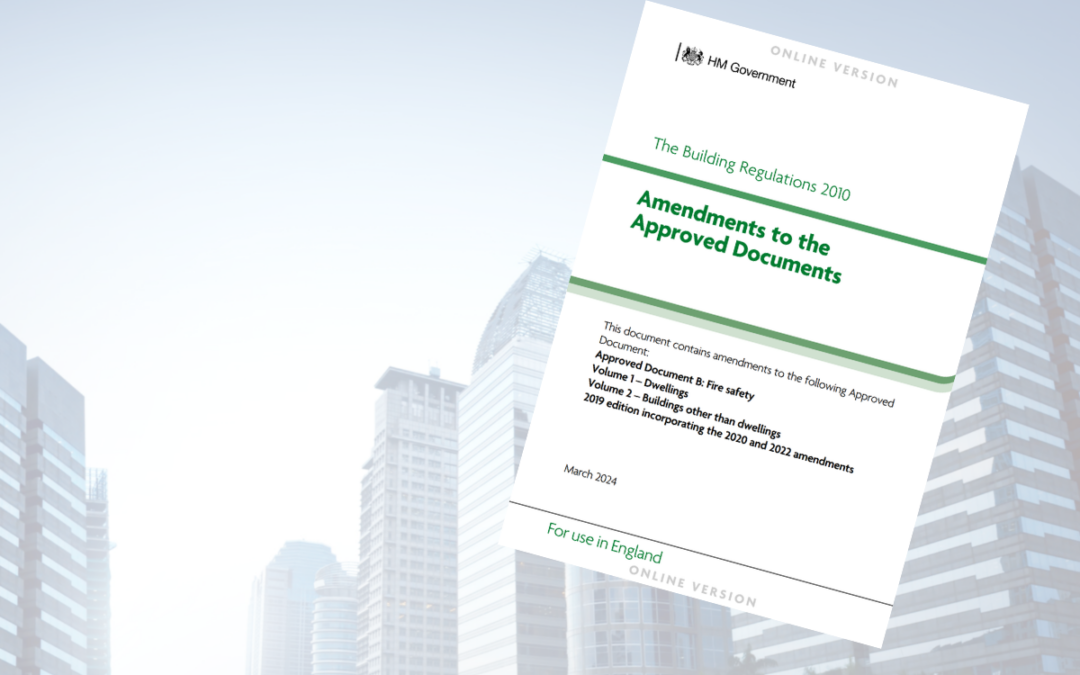
The Government has published a document listing amendments to Volumes 1 and 2 of Approved Document B which will come into effect in September 2026.
These amendments principally concern:
- Threshold for the provision of a second staircase in blocks of flats with a storey 18m or more in height.
- Evacuation shafts are introduced to support the provision of evacuation lifts.
- Changes to provisions for fire doorsets.
- New terminology including definitions for evacuation shaft, evacuation lift lobby, interlocked stair and storey exit.
- Provisions for horizontal escape and vertical escape separated as per the structure of Volume 2.
The 2019 edition incorporating the 2020 and 2022 amendments will continue to apply where a building notice or an initial notice has been given to, or a building control approval application with full plans made to, the relevant authority before 30 September 2026 and either the building work to which it relates:
- has started and is sufficiently progressed before that day; or
- is started and is sufficiently progressed within the period of 18 months beginning on that day
You can view the amendments at the link below:
Fire safety: Approved Document B
FIS will publish further detailed guidance on these changes in the coming months.
See more news likes this

Guidance for dealing with retentions payments under NEC Contracts
The Construction Leadership Council (CLC) in collaboration with NEC has today published joint guidance to industry on the use of retention clauses under NEC3 and NEC4 Engineering and Construct Contracts (ECC), and sub-contracts. The publication explains how NEC...

Businesses to be given UK product marking flexibility
Businesses will be given an additional two years to apply new product safety marking, giving thousands of businesses the freedom to focus on growth, Business Secretary Grant Shapps has announced today (Monday 14 November). The UK Conformity Assessed (UKCA) marking has...

Guidance on employment entry into construction
Build UK has published a guide setting out the most common Routes of Entry in Construction for young people in England leaving school, including apprenticeships, traineeships, T Levels and degrees, and how they might suit different employers. Although the routes of...