
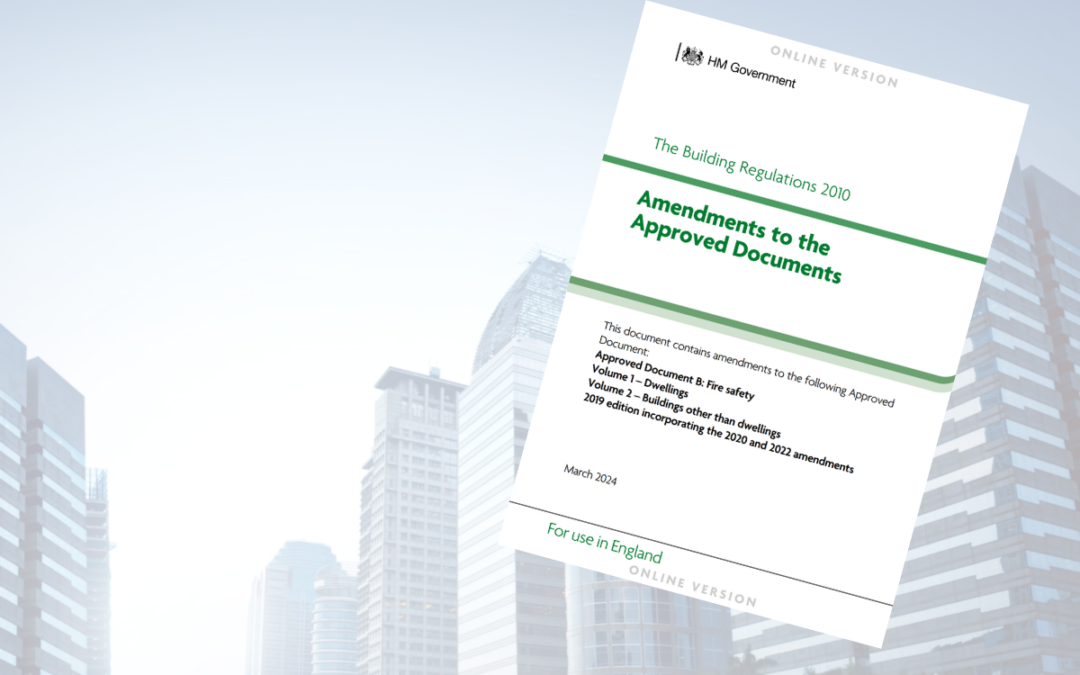
The Government has published a document listing amendments to Volumes 1 and 2 of Approved Document B which will come into effect in September 2026.
These amendments principally concern:
- Threshold for the provision of a second staircase in blocks of flats with a storey 18m or more in height.
- Evacuation shafts are introduced to support the provision of evacuation lifts.
- Changes to provisions for fire doorsets.
- New terminology including definitions for evacuation shaft, evacuation lift lobby, interlocked stair and storey exit.
- Provisions for horizontal escape and vertical escape separated as per the structure of Volume 2.
The 2019 edition incorporating the 2020 and 2022 amendments will continue to apply where a building notice or an initial notice has been given to, or a building control approval application with full plans made to, the relevant authority before 30 September 2026 and either the building work to which it relates:
- has started and is sufficiently progressed before that day; or
- is started and is sufficiently progressed within the period of 18 months beginning on that day
You can view the amendments at the link below:
Fire safety: Approved Document B
FIS will publish further detailed guidance on these changes in the coming months.
See more news likes this
Project reuse launches practical flowcharts to help transform product reuse in the finishes and interiors sector
New guidance provides a clear roadmap for industry stakeholders to maximise the reuse of construction products and accelerate the transition to a circular economy. Project Reuse has launched three practical flowcharts designed to help the finishes and interiors sector...

Discounted supervision and management NVQs available for FIS members
The Skills Centre, an approved training provider for the sector, delivers a range of NVQ qualifications. As part of its commitment to supporting the sector, FIS members benefit from an exclusive 10% discount on each of the NVQs listed below, helping businesses and...

Updated: Guidance for FIS members on the administration of Zentia
FIS Member Note: Zentia Administration FIS legal advisers, Hill Dickinson, have provided guidance for FIS members regarding the current administration of Zentia. The note includes guidance on products already in situ on schemes that are nearing completion (i.e. in...