
by Clair Mooney | 7 May, 2021 | Skills
Nation Council Chair vacancies: Help shape the future of construction skills
CITB is seeking senior, experienced and knowledgeable industry representatives for its Nation Council Chair in England and Scotland.
The Nation Councils have an important role in supporting the CITB Board in its strategic leadership, by providing insight into industry challenges, across nations, regions and sectors and acting as a sounding board for Trustees. Applications are invited from across the industry, including SMEs, large employers, and independent consultants. The Nation Council Chair will help shape the future of construction as the industry begins to emerge from the shadow of the pandemic and adapt to new challenges, including Brexit and achieving Net Zero targets. They will:
- Capture and articulate to the Board key issues affecting or likely to affect industry;
- Assist the Board to accurately prioritise support for key issues affecting industry across Great Britain;
- Help review and advise the Board on CITB’s Business Plan to ensure that it addresses industry opportunities, pressures and priorities;
- Shape individual Nations Plans and to review performance against them; and
- Make recommendations to the Board about extraordinary matters arising that may impact on the ability of the Board to deliver the Plan.
Interested candidates should have a wealth of senior level experience in the sector and represent the voice of industry. It is essential that the Chair has a sound knowledge and understanding of both their nation and the wider construction landscape.
CITB Policy Director Stephen Radley said: “The role of Nation Council Chair is challenging and incredibly rewarding and represents the perfect opportunity for someone with industry insight and an understanding of the challenges facing the sector to make their mark. To fill the shoes of our current Chairs will be no easy task but we know the construction industry is full of incredibly talented people who I know will rise to the task.”
CITB is also recruiting independent members of its Audit and Risk, and Industry Funding committees. Anyone interested in applying for the vacancies should visit: http://sscl-innovation.com/CITBmicrosite/volunteering/

by Clair Mooney | 5 May, 2021 | Skills
CITB has published its End of Year Progress Report. This performance report shows progress against a plan reprioritised significantly when the pandemic hit back in March 2020. CITB has indicated that they will continue to develop the simpler, more targeted plan and new delivery approaches (including the focus on digital), into this year’s business plan.
Highlights identified in the plan included:
- suspending Levy collection as businesses faced critical cash challenges.
- offering an advanced apprenticeship grant which saw £3.4 million paid to over 2,000 employers.
- providing e-learning and remote working, with remote learning and new courses ensuring qualifications were not a barrier to returning to work.
- Offering Covid-19 support which saw 21,800 people complete our pandemic health and safety eCourse
Encouragingly, as few as 248 out of 11,000 CITB’s apprentices were made redundant during the pandemic. More than half of those that were made redundant have been placed with alternative employers to help get them to completion, and CITB continues to support others who have not been successfully replaced to restart their apprenticeship. CITB grants have supported 23,322 apprentices, and 8,883 employers.
Employers proved to be much more resilient than expected in the reforecast at the outset of the pandemic meaning Levy receipts were significantly higher than envisaged and a total of £122.5m was collected. The excess of £48.7m will be carried forward and used on Grants Scheme and funding programmes in 2021-22 when Levy income is anticipated to be approximately £96m less than a normal year.
Grants and funding expenditure was £5.5m below forecast, however demand for advanced apprenticeship grants held up better than expected. Direct support costs for apprentices was also above plan, by £9.7m, making overall investment in apprentices £89.3m, £16.7m above plan. This was part-funded by lower than forecast claims of grants and funding (£14.5m) and savings in operating costs (£4.1m).
George Swann, Skills and Training Lead at FIS stated: “This report quantifies CITB’s activities between April 2020 and March 2021, the executive summary provides a snapshot. The detail gives an indication of what grants and funding employers can and should apply for and if the bid is aligned to the statements in this report you should be successful. If you need assistance the FIS Skills and Funding Clinic will help, just fill in the form at: https://www.thefis.org/registration-form/ and we will contact you.”
You can access the report here.
by Clair Mooney | 5 May, 2021 | Drylining, Skills
FIS is working to support an increase in availability, quality an uptake of apprenticeships in the sector to help address labour shortages linked to the new immigration system. We need the sector to rally to help accelerate this work.
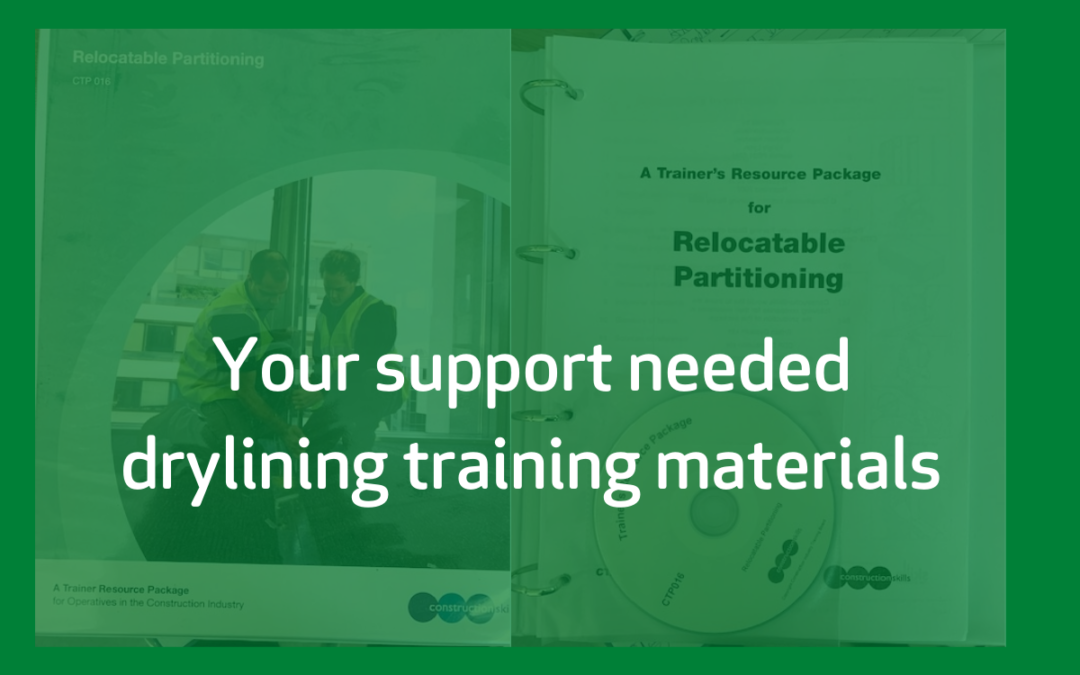
We are particularly keen at the moment to get sight of any materials, documents, folders, electronic data and images that are being or have been used to deliver training for Dry Liners (from suppliers to support their customers, training providers or internal resources from contractors). At this stage, absolutely anything and everything you send will be considered and possibly used in the production of a single standardised trainer package that can be accessed by all FIS Approved Training Providers and Employer members. The aim is to ensure a consistent standard of training is delivered across the UK and that employers will know what to expect from and how to support training providers.
If you have anything that you feel can be used to support (links, files, documents, animations, videos, youtube clips etc) please email to georgeswann@thefis.org or post to FIS, Olton Bridge, 245 Warwick Road, Solihull, B92 7AH. There is a specific package produced by CITB around 2007 that we are particularly keen to get our hands on. The inside cover contains a CD and this has been identified as a good starting point for reviewing and updating the core Dry Lining training support materials, if you can copy or send this to FIS, it would be a great help. Many thanks in anticipation and any questions, please don’t hesitate to call us on 0121 707 0077.
An image of a similar the pack
We have also set up an employers group to support the development of the Interior Systems Installer Apprenticeship and Drylining Apprenticeship in Scotland – the next meeting is set for 19 May – if you are interested in attending, you can register to attend here.
Thanks in advance from your support and please don’t hesitate to contact George Swann me with any questions, comments or thoughts.
by Clair Mooney | 29 Apr, 2021 | Skills
Employer representative bodies are being asked by government to step forward and lead pilots for new local skills improvement plans (LSIP). First mooted in the FE white paper, the plans will aim to make colleges align the courses they offer to local employers’ needs.
They are hoped to address concerns that employers do not currently have enough influence over the skills provision offered in their locality and struggle to find staff to fill their skills gaps. Keith Smith, the director for post-16 strategy at the Department for Education, told an FE Week webcast last month that new legislation is being worked on to enable the education secretary to intervene where colleges refuse to deliver courses decided through LSIPs. Led by “established employer representative bodies”, such as chambers of commerce, as a Trade Body FIS is an Employer Representative Body, the plans will be piloted in six to eight trailblazer areas this year, backed with £4 million of revenue funding. The funding must be spent by the end of March 2022.
In application guidance published last week, the Department for Education said the plans will “set out the key changes needed to make technical skills training more responsive to employers’ skills needs within a local area”. They should be created in collaboration with colleges and training providers, with employers setting out a credible and evidence-based assessment of their skills needs, to which providers will be empowered to respond. The plans will help ensure provision is more responsive to emerging and changing skills needs and being locally driven, can be tailored to the challenges and opportunities most relevant to the area, the guidance added. In the longer-term, the government hopes LSIPs will support and complement its reforms to the FE funding system, which will give providers more autonomy to use government funding to meet the skills needs of local employers.
In return, the DfE adds, we will reform the accountability system to focus less on process and more on the effectiveness of provider performance and the outcomes they achieve. By taking a more outcome-focused approach, providers will be incentivised to continually review their provision to ensure it leads to meaningful employment for their learners, scaling back where there is an oversupply of provision and expanding other areas in line with agreed LSIP priorities, the department continues. The plans will be put on a statutory footing and DfE promises to “develop an accountability structure for local areas to ensure that providers are engaging in the process and contributing to actions they have agreed.
George Swann, FIS Skills and Training Lead says: this is great news, it means colleges will be duty bound to provide training and qualifications that meet local employer demand. I encourage FIS employer members to get involved with this, get together and tell us what you expect from your local college what skills you need to support your business.

by Clair Mooney | 29 Apr, 2021 | Skills
CITB has announced that they are retaining the CITB National Construction Colleges (NCC) in Norfolk and Glasgow. The facilities offer mainstream and apprentice training in Dry Lining, Partitions and Ceiling Fixing. More details about the training available can be found here.

by Clair Mooney | 29 Apr, 2021 | Skills
The new flexi-job apprenticeship schemes were announced by the Chancellor in the last Budget. It is proposed that the schemes will build on the existing Apprenticeship Training Agency model, to allow employers to join forces and access funding to create new or expand existing schemes to boost the use of apprenticeships in sectors with non-traditional employment patterns, including construction. DfE will launch the flexi-job apprenticeships fund in July 2021 with employers set to be invited to bid for a share of a £7 million fund to create and test new flexi-apprenticeships schemes, with the first approved flexi-job apprenticeships expected to start in January 2022.
A consultation seeking views on DfE vision and operating framework for flexi-job apprenticeship schemes as a means to increase the use of apprenticeships in certain sectors and professions. Apprenticeships are more important than ever in equipping individuals and businesses with the skills they need as we build back better from the coronavirus (covid-19) outbreak. Government want to make sure apprenticeships reflect modern models of employment for all employers in all sectors. They are developing portable apprenticeships, putting apprentices in the driving seat and enabling them to move between employers in industries where short-term contracts are the norm. This consultation asks you to consider how flexi-job apprenticeship schemes can support the growth of apprenticeships in sectors where short-term and project-based contracts are the norm. To complete the survey please go to: Flexi-Job Apprenticeships: Reshaping the role of Apprenticeship Training Agencies – Page 1 of 7 – Department for Education – Citizen Space
This flexi-job apprenticeship consultation will close on 1 June 2021.
George Swann said: “This scheme has potential for encouraging employers in the finishes and interiors sector to collaborate in the training of apprentices. Although the focus is on the duration of the apprenticeship programme, a Flexi-job apprenticeship could provide individuals with more variety than they may get when working with a single employer, which could ensure they cover every criteria listed in the Apprenticeship Standard prior to the end test. FIS will keep a watchful eye on this as it develops. Please take a few minutes to complete the survey”.