
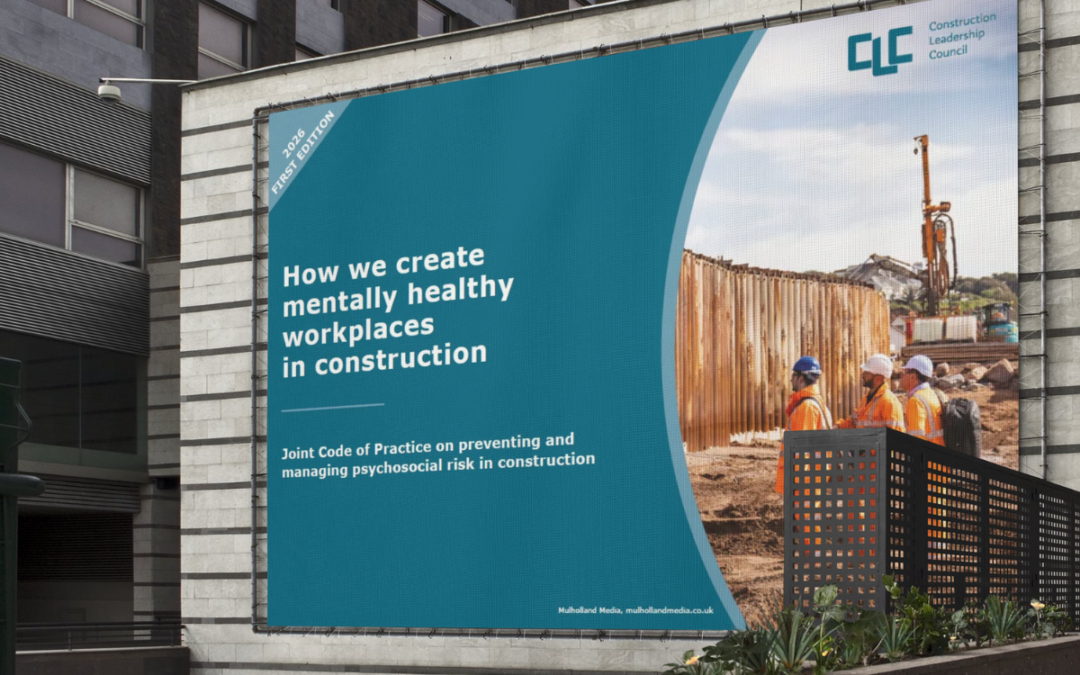
The Construction Leadership Council (CLC) has published its Mental Health Joint Code of Practice (JCOP), providing leaders and businesses across the sector with a framework to create an environment that fosters better mental health for their workforce.
The sector continues to lose too many people to suicide, and in today’s world, with the plethora of existing support services, this is unacceptable. The health, safety and wellbeing of our workforce must be of paramount importance.
Whilst we recognise there is great work taking place across the construction sector in the mental health space, for too long those efforts have focused mainly on intervention, once people are already struggling. As a new approach, the JCOP is designed through the lens of prevention, enabling businesses to support employees before it reaches that stage.
Our evidence from a representative sample of our core demographic – men in mid to later working life, also shows that workers face multiple barriers to speaking up on these issues England’s first Men’s Health Strategy aims to improve the health and wellbeing of all men and boys in England, recognising that men’s health outcomes are significantly shaped by work and working conditions. It also considers how to prevent and tackle the biggest health problems affecting men of all ages, which include mental health and suicide prevention. The cross-government Suicide Prevention Strategy for England, published in 2023, sets the ambition for employers, especially those in high-risk occupations, to have appropriate mental health and wellbeing support in place for their staff. The new cross-government mental health strategy, to be published later this year, will look beyond the NHS and consider the role of workplaces, schools, the voluntary sector and local government to respond more proportionately to needs and promote positive mental health.
Today’s publication is supported by the Department of Health and Social Care.
The JCOP fundamentally changes the narrative in this space, bringing together key stakeholders across the sector and beyond to take a system thinking based approach, through the lens of prevention.
It will be trialled at 33 Piccadilly and 10 Piccadilly in London – two of The Crown Estate’s new developments in the heart of the capital – working alongside their partners at Kier Construction.
The CLC has worked with its programme partners (New Hospital Programme, Marsh and BCLP), supported by key influential organisations (e.g. Mindflow, Lighthouse Charity, and British Standards Institute) and a cross section of the UK’s leading influential contractors to develop the JCOP, which is endorsed by Government, informed by industry and underpinned by academic evidence.
Affected on the ground workers (through a series of regional focus groups) and industry (through our 3000 consultation responses) told us that the core primary causes impacting the workforce’s mental health are:
- Working Patterns (e.g. long hours and excessive travel)
- People Factors and Work Environment (Welfare, Dignity and Respect)
- Operational Factors (e.g. commercial pressures)
- Barriers to Mental Health support (stigma and low mental health literacy stop people getting help)
- Financial Factors (Late payment and financial insecurity)
The Code is designed as a catalyst and living framework to address these five key hazards: a credible baseline now, which will be strengthened over time through shared learning, data and realworld case studies.
It is evidence-led, moving businesses from response to prevention. It provides- through an improved understanding of those five primary psychosocial hazards in construction- practical workplace solutions to help clients, employers and the supply chain to prevent harm earlier, driving down the incidence of ill health throughout all levels of the industry.
It recognises a simple truth that has come through repeatedly in our evidence gathering: mental ill health is not an inevitable feature of construction, and it is not a problem to be managed solely through individual resilience or support after the fact. It is, to a significant extent, shaped upstream by how work is commissioned, designed, procured, planned, sequenced and led.
This is about prevention first, not prevention only. The JCOP does not replace crisis support which remains essential. The JCOP shifts the focus earlier, helping the industry prevent work-related pressures from becoming crises in the first place.
The invitation is simple to leaders and business: adopt it, use it, improve it — and help the sector move forward together, in step, towards work that is healthier by design.
This is a joint code, written by the sector, for the sector. It reflects the reality that no single organisation can deliver change in isolation. The only way that we will be able to improve mental health in UK construction, is if the industry moves together collectively, and works in partnership.
Baroness Merron, Minister for Mental Health, said:
“It is really encouraging to see the construction industry taking this crucial step to ensure the wellbeing of its workforce, and I hope it sets a strong example for other sectors to follow.“This government believes mental health is just as important as physical health, which is why we are investing record amounts in mental health services and recruiting more mental health professionals than ever before.
“Mental health is shaped not just by healthcare services, but at work, at home, in schools and in our communities. That’s why this initiative is so important and why our new, cross-government mental health strategy will drive the shift from crisis intervention to preventative care.”
This work was spearheaded for the CLC by The Department for Business and Trade, Heathrow, The Crown Estate, BAM UK and Ireland, Mates In Mind and The University of Warwick and supported by their partners Marsh, BCLP and the New Hospital Programme.