
Conflict in the Middle East and its potential impacts on the global economy, the UK economy and the construction industry cast a dark shadow over the forecasts for 2026 and 2027. It appears increasingly likely that the second half of this year will see a drop in demand and sharp cost rises. How long the global disruption and high oil and energy prices last remains uncertain at the time of writing, and the CPA has had to make assumptions about the extent and duration of the supply shock.
However, based on the CPA’s assumptions, construction output is now forecast to fall significantly in 2026, with growth in 2027 also adversely affected. The largest of the conflict impacts are likely to be felt on both the demand and supply side for private housing and private housing repair, maintenance and improvement (rm&i), the two largest construction sectors. In addition, the risks to the forecasts remain heavily skewed to the downside, although potential upside risks remain if the government provides stimulus to boost demand and reduces its additional cost burdens on the construction industry. In addition, all construction forecasters continue to highlight the major problems with the Office for National Statistics (ONS) construction output data on which construction forecasts are based, so users should treat the historical data with extreme caution.
At the end of last year, with the uncertainty created by the government’s Autumn Budget out of the way and with an expected slight acceleration in UK growth this year, there was a degree of cautious optimism over prospects for many key construction sectors in 2026 and 2027. However, the start of this year was already challenging for construction, with persistent rain affecting activity, particularly outdoor work and the start of new projects. The hope was that better weather in March and April would lead to stronger activity, and this appeared to have occurred, although there was little evidence of any significant ‘catch-up’ activity delayed at the start of the year. But the Middle East conflict is likely to raise its own challenges for the UK economy and the construction industry in particular. Even if there was a resolution to the conflict on the day of the forecasts being published, a degree of permanent damage would be done to oil production, shipping channels, and additional global uncertainty and risk would be priced in, which is likely to lead to both a spike in CPI inflation across the economy and construction product price inflation due to oil, energy and input cost rises.
Privately funded construction sectors are most likely to be affected by these cost increases. In addition, privately funded construction sectors will be affected by increases in mortgage and financing costs, which will hit homebuyers and site viability, respectively. Publicly-funded and regulated sectors are likely to be less affected by these issues and with strong pipelines of activity in some areas, clients may be more willing to accept cost rises on projects over the next 12-18 months. However, if not, these sectors may also suffer from project viability issues and major contractors’ and consortia’s unwillingness to sign up to large projects in an uncertain cost environment, given the increasing risk.
Due to the uncertainty over how long the disruption will last, how high oil and energy prices will peak, and how long they will remain at those peaks, the CPA’s forecasts are based on oil prices remaining above $100 per barrel for four months, which occurred in 2022 after Russia’s invasion of Ukraine. The CPA also has an Upper Scenario, which assumes oil prices remain above $100 per barrel for 2 months.
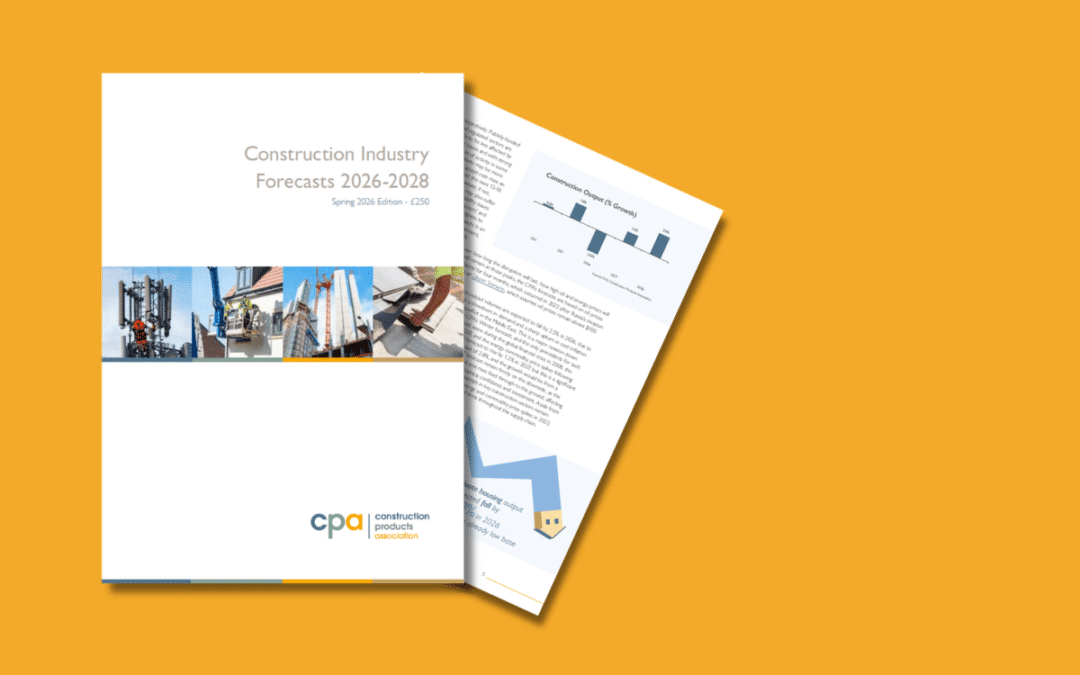
In the CPA’s forecast, construction output volumes are expected to fall by 2.5% in 2026, due to a weather-affected Q1, followed by a slowdown in demand and a sharp upturn in cost inflation in H2, driven by the impacts of the conflict in the Middle East. This is a major revision down from the 1.7% growth forecast in the CPA’s Winter forecast, and the only precedents for such large downward revisions to the forecasts were during the global financial crisis in 2008, the initial Covid-19 pandemic lockdown in 2020, and the energy commodity price spikes following Russia’s invasion of Ukraine. Output is still forecast to rise by 1.2% in 2027, but this is a significant revision down from the CPA’s Winter forecast of 2.8%, and the growth would be from a lower base. In addition, the risks to the 2027 forecast remain firmly on the downside, as the lagged impacts of borrowing rate increases and cost rises feed through to the ground, affecting consumer confidence and spending, as well as business confidence and investment. Aside from issues arising from the recent conflict, the fundamentals in key construction sectors remain unchanged. However, as with the impacts of the energy and commodity price spikes in 2022, the recent conflict is likely to affect the cost bases of firms throughout the supply chain.