
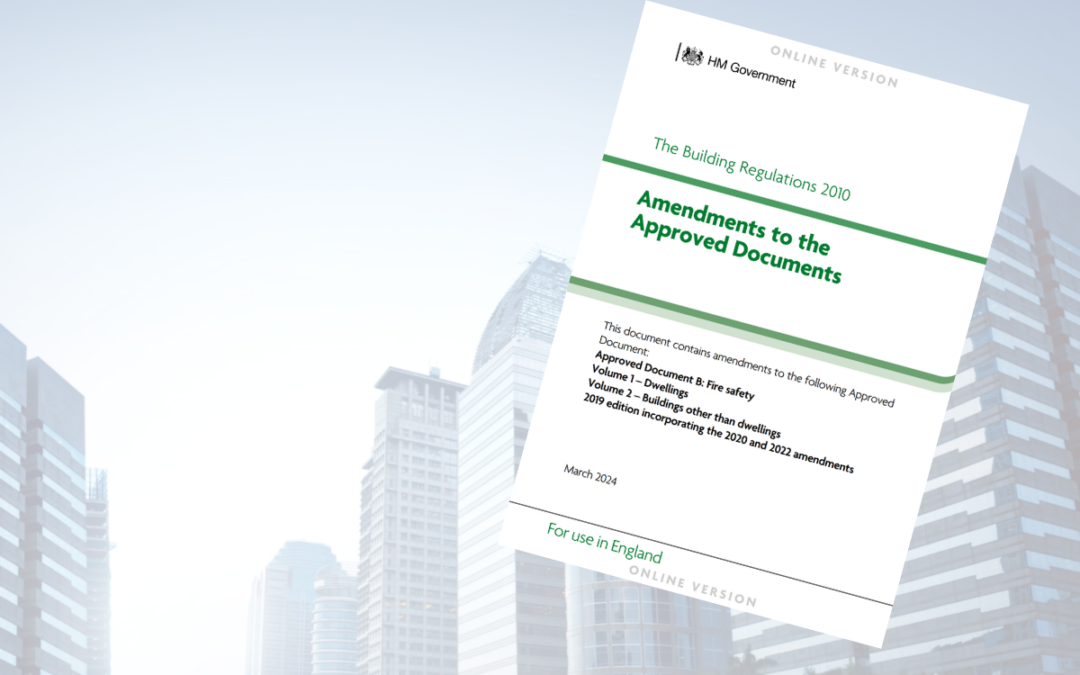
The Government has published a document listing amendments to Volumes 1 and 2 of Approved Document B which will come into effect in September 2026.
These amendments principally concern:
- Threshold for the provision of a second staircase in blocks of flats with a storey 18m or more in height.
- Evacuation shafts are introduced to support the provision of evacuation lifts.
- Changes to provisions for fire doorsets.
- New terminology including definitions for evacuation shaft, evacuation lift lobby, interlocked stair and storey exit.
- Provisions for horizontal escape and vertical escape separated as per the structure of Volume 2.
The 2019 edition incorporating the 2020 and 2022 amendments will continue to apply where a building notice or an initial notice has been given to, or a building control approval application with full plans made to, the relevant authority before 30 September 2026 and either the building work to which it relates:
- has started and is sufficiently progressed before that day; or
- is started and is sufficiently progressed within the period of 18 months beginning on that day
You can view the amendments at the link below:
Fire safety: Approved Document B
FIS will publish further detailed guidance on these changes in the coming months.
See more news likes this

FIS appoints Head of Skills and Training
FIS is delighted to announce the appointment of Beena Nana as Head of Skills and Training. In her first three months Beena will be concentrating on the FIS BuildBack programme which ends this year, before taking over from Skills and Training Lead George Swan who...
Welsh Government seeks contractors views on Warm Homes Programme
The Welsh Government is committed to a greener, fairer future. Improving existing homes helps tackle fuel poverty and create much-needed jobs, training opportunities, and supply chains. In Wales, 1.4 million homes are responsible for 27% of all energy consumed and 15%...

Addressing rising construction costs in Scotland
The Scottish Government recognises the significant pressures currently faced by the construction industry due to the dramatic rise in the cost of fuel and materials, inflation, and stretched public budgets. These pressures, coming on top of the continued impact from...